Burlap looks simple until a needle goes into it. The threads of the fabric are thicker than most embroidery thread, so stitches sink, slip between the weave and vanish. A little prep fixes almost all of that, and this guide covers the prep.
Embroidery on burlap works when you back the fabric with a medium cutaway stabilizer and cover it with a water-soluble topping. Pick designs with solid, filled stitching. Burlap is the same fabric as hessian, a coarse weave made from jute fibers. The steps below suit machine embroidery, and later sections cover cross stitch, sewing and hand stitching.
What Is Burlap, and Why Is It Hard to Embroider On
This section is for anyone who has pulled a burlap sack out of the garage and wondered if it can hold a design. It can, with a few adjustments.
Burlap is an open, loosely woven cloth. Hessian is the name used in the UK and Australia, and the fabric is identical.
Gaps between the threads let a needle slip through at odd angles. The surface is so bumpy that thin lines of thread sit down inside the weave instead of on top of it. We stitch everything we sell on dense cotton and fleece, so burlap is a different animal. The same rule applies to both, though: the fabric needs support behind the needle.
Embroidery on Burlap: What to Gather First
Read this list before you go shopping, because the wrong burlap or stabilizer is the usual reason a project fails.
Choose the right burlap
Finer, tighter burlap shows stitches better than the coarse kind sold for garden wraps. Hold the fabric up to a window. If you can see daylight through big square holes, keep looking.
Natural tan is the classic choice. Dyed burlap and cotton blends are easy to find in craft stores and give a calmer surface. Pre-cut runners and bags work too, as long as you can hoop them flat.
Needle, thread and stabilizer
- Needle: a sharp 75/11 machine needle. A ballpoint pushes threads aside, and a sharp one pierces them.
- Thread: standard polyester or rayon embroidery thread. Thicker weights show up better.
- Stabilizer: medium-weight cutaway. Tear-away lets go of the stitches once the needle perforates it, which is not enough here. See our notes on cutaway stabilizer for how it behaves on other fabrics.
- Topping: water-soluble film that sits on the right side and keeps stitches from sinking.
- Extras: temporary spray adhesive, and a scrap of light fabric if the burlap is very open.
How to Embroider on Burlap in 7 Steps
Use these steps for a hooped machine, from a fresh piece of fabric to a finished design.
- Pick a design with solid fills and bold shapes. Satin columns wider than a few millimeters work, and so do lettering and block icons.
- Seal the cut edges with a zigzag line or a dab of fray preventer, so threads do not unravel.
- Spray the cutaway stabilizer lightly and smooth the burlap onto it, wrong side down against the adhesive.
- If the weave has big holes, slide a light-colored scrap between the burlap and the stabilizer so the backing does not show.
- Lay the water-soluble topping on the right side with no adhesive, then hoop all layers firmly. Our hooping guide has tips for keeping a hoop snug on awkward items.
- Slow the machine down and stitch the design. Burlap is bumpy, and a slower speed gives cleaner edges.
- Tear off the loose topping, then dab the leftover bits with a damp cloth. Leave the cutaway in place or trim it, depending on how much shows through.
If the stabilizer shows through the weave, either leave it as a full backing or sew the finished piece to a lining. Either choice looks deliberate, while a ragged trimmed edge does not.
Cross Stitch on Burlap by Hand
Choose this route if you do not own an embroidery machine, or if you want a small, quiet project for an evening.
Cross stitch on burlap is more forgiving than it sounds, because the weave already gives you a grid. Burlap threads are uneven, so count over the same number of threads for every stitch. Check your rows as you go.
Use a blunt needle with a large eye, since a sharp one splits the fibers. Embroidery floss works well. Try three or four strands at first and add more if the stitches look thin.
A hoop or a scroll frame keeps the grid from warping, and masking tape over the fabric edges stops fraying. Our guide to cross stitch patterns has chart ideas you can scale up for a coarse weave.
Sewing on Burlap Without Fraying
This part is for makers who are turning burlap into bags, table runners and wall hangings, and who are stitching seams rather than designs.
Sewing on burlap is straightforward once the edges are under control. Cut with sharp shears, then finish each edge before you sew. A zigzag stitch along the raw edge works, and so does a narrow fold pressed under with a hot iron.
Clips hold layers more gently than pins. Burlap also sheds tiny fibers, so brush your machine out afterward.
Sewing with hessian: needle and thread
Sewing with burlap fabric goes best with a size 90/14 or 100/16 needle. Use polyester thread, which holds up against rough fibers better than cotton does. Lengthen the stitch to about 3 mm so the needle does not perforate the weave too tightly. For heavy hessian sacks, a denim needle copes with thick seams.
Turning an embroidered panel into a bag? Add a lining. Our embroidered tote bags use thick canvas that holds its shape alone, and burlap is much floppier.
Burlap Stitching That Shows Up
Pick the stitch before you pick the thread color. Some stitches read clearly on a rough surface, and others disappear.
Burlap stitching worth using
Satin stitch, fill stitch, chain stitch and thick couching all hold their shape. For hand work, a heavy thread in a chain stitch outlines a letter well. On a machine, higher stitch counts give the density that burlap swallows up.
Stitches to avoid
Skip running stitch, redwork outlines and fine single lines. A single thread of embroidery floss is thinner than one thread of burlap, so it just falls between the gaps. If you want a line, use a column of satin stitch or three parallel lines of chain stitch.
Common Problems and How to Fix Them
Come here when a test piece looks wrong, before you scrap the whole project.
- Stitches look sunken: add or re-spray the water-soluble topping, and check that the design has enough density.
- The fabric puckers around the design: hoop tighter, add a heavier cutaway, and avoid stretching the burlap into the hoop.
- Thread keeps breaking: swap the needle for a fresh sharp 75/11, since burlap dulls needles quickly.
- Gaps show the backing: add the light fabric layer, or pick a burlap with a tighter weave.
- Edges unravel: finish them before you hoop, never after.
Test every new design on a scrap first. We do this with each new pattern before it goes on a sweatshirt. A few minutes on scrap fabric shows density problems that a preview screen hides.
Caring for Embroidered Burlap
Read this before you give a finished piece away or wash anything.
Burlap does not like soaking. Spot-clean with a damp cloth and let it air-dry flat. If you need to wash a piece, use cold water and expect some shrinkage and a few loose fibers.
Press from the back on low heat with a pressing cloth, never straight onto the stitches. Our guide to washing embroidered clothing covers the general rules for the rest of your wardrobe.
Ideas for Burlap Projects
These ideas are for anyone who has the basics down and wants a first real project.
- A table runner with a monogram in the middle.
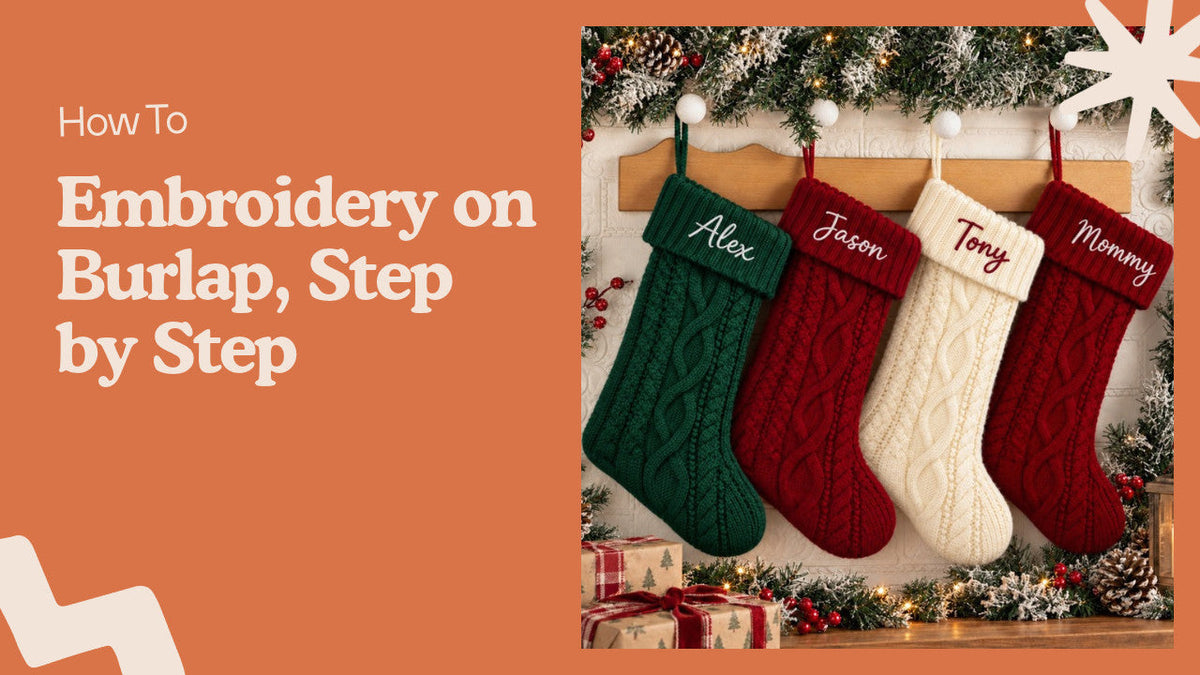
- A Christmas stocking in a rustic, homespun look, with a name along the cuff.
- A wall hanging with a short phrase in bold satin letters.
- Gift bags with a simple icon, lined in a printed cotton.
- Coasters made from stiffened burlap with a small filled motif.
- A farmhouse-style pillow cover with a block-letter word.
If you would rather skip the prep and give someone a finished piece, browse our personalized embroidered gifts. We stitch each item to order on cotton, fleece and canvas, with a stabilizer behind every design.
FAQ About Embroidering on Burlap
Can you embroider on burlap with a machine?
Yes. Back the burlap with a medium cutaway stabilizer, add a water-soluble topping and use a sharp 75/11 needle.
What stabilizer is best for embroidery on burlap?
A medium-weight cutaway, sprayed to the wrong side, plus a water-soluble topping on the right side. Tear-away is too weak for this rough, open weave.
Is burlap the same as hessian?
Yes. Hessian is the UK name for burlap, and both are woven from jute fibers.
Can you cross stitch on burlap?
Yes. Count threads carefully, use a blunt large-eyed needle, and stitch with three or four strands of floss. A hoop helps keep the grid straight.
Can you sew on burlap with a regular sewing machine?
Yes, with a 90/14 or 100/16 needle, polyester thread and a longer stitch length. Finish the raw edges first so they do not fray.
How do you stop burlap from fraying?
Zigzag the cut edges, fold and press them under, or apply a dab of fray preventer. Do this before you hoop or sew.