The number printed in a blank tee catalog, say 5.3 oz, is not what the shirt weighs. It describes the fabric, measured per square yard, before anyone cuts or sews it. Once you know that, custom t-shirt weights stop being confusing and start being useful.
A typical adult t-shirt weighs about 5 to 7 ounces (roughly 140 to 200 grams) on a scale. A small lightweight tee can come in near 3 ounces, and a heavyweight 2XL can pass 10 ounces. The figure on the label is fabric weight. Lightweight runs about 3.5 to 4.5 oz, medium weight 4.5 to 5.5 oz, and heavyweight 5.5 oz or more.
We are an embroidery shop, so we look at fabric weight from one angle most print guides skip. Thread is heavier than ink, and a thin shirt has to carry it.
How much does a t-shirt weigh, and what shirt weight means
This section is for anyone comparing blanks, estimating postage, or wondering why two "cotton tees" feel nothing alike. There are two different weights in play, and catalogs rarely say which one they mean.
Fabric weight is the mass of one square unit of cloth. In the US it is written in ounces per square yard (oz/yd²). Most other countries use grams per square meter, shortened to GSM.
Garment weight is what the finished shirt weighs on a kitchen scale. It depends on fabric weight, the size of the shirt, and extras like ribbed collars, labels, and stitching.
You can estimate garment weight with simple math. Multiply the GSM by the square meters of fabric in the shirt. An adult medium uses a little under one square meter. So a 180 GSM tee works out to about 0.85 × 180 = 153 grams, or about 5.4 ounces, before thread and tags.
For an exact number, put the shirt on a kitchen scale. That takes ten seconds and beats any formula.
Converting ounces to GSM
Use this when a supplier lists one unit and you think in the other. One ounce per square yard equals about 33.9 GSM.
- 3.5 oz/yd² = 119 GSM
- 4.0 oz/yd² = 136 GSM
- 4.5 oz/yd² = 153 GSM
- 5.0 oz/yd² = 170 GSM
- 5.5 oz/yd² = 186 GSM
- 6.0 oz/yd² = 203 GSM
- 6.5 oz/yd² = 220 GSM
Some brands also quote linear ounces, measured on a long strip of fabric instead of a square. Those numbers run lower for the same cloth. If two figures look oddly far apart, ask which method was used.
Lightweight t-shirts
Lightweight tees suit hot climates, layering under a jacket, and anyone who hates feeling a shirt on their body. Expect fabric under 4.5 oz, often in a fine combed or ringspun yarn.
The drape is soft and the shirt moves with you. The trade-off shows up fast in pale colors, which can turn slightly see-through.
Durability is the other cost. Thin cotton tends to twist at the side seams after a few washes, and the collar can wave out. For a one-day event shirt, none of that matters much.
Medium weight t-shirts
Most people mean this middle range when they picture a "normal" tee. Fabric sits around 4.5 to 5.5 oz, which covers a large share of standard blanks.
It is opaque enough for white and heather colors. It is still comfortable in summer. And it takes most decoration methods without fuss.
If you are ordering for a group with mixed tastes, start here. Few people will complain it feels too thin or too stiff.
Heavyweight t-shirts
Pick heavyweight when you want a shirt with structure: boxy streetwear fits, workwear, or a tee that still looks crisp after a year. Fabric weight starts around 5.5 oz and can go past 7 oz.
The collar keeps its shape longer. The body hangs straight instead of clinging. In July, though, a 6.5 oz shirt is warm, and nobody pretends otherwise.
Heavier fabric also tolerates more. That matters if the shirt will carry dense stitching, which leads to the next point.
Fabric weight and embroidery
This part matters if your custom shirt will be stitched rather than printed. Embroidery pulls on fabric in a way ink never does.
Every stitch tugs the cloth toward the design. On a thin tee, that pull shows up as puckering, a wavy ring around the lettering. Heavier knits resist it better because there is more fiber to hold each stitch.
We put a stabilizer layer behind every design so the stitches sit flat. New designs get a test run on scrap fabric first, and we adjust stitch density before anything touches a real garment. A detailed design can still take 4 to 9 minutes on the machine, which is a lot of thread going into one spot.
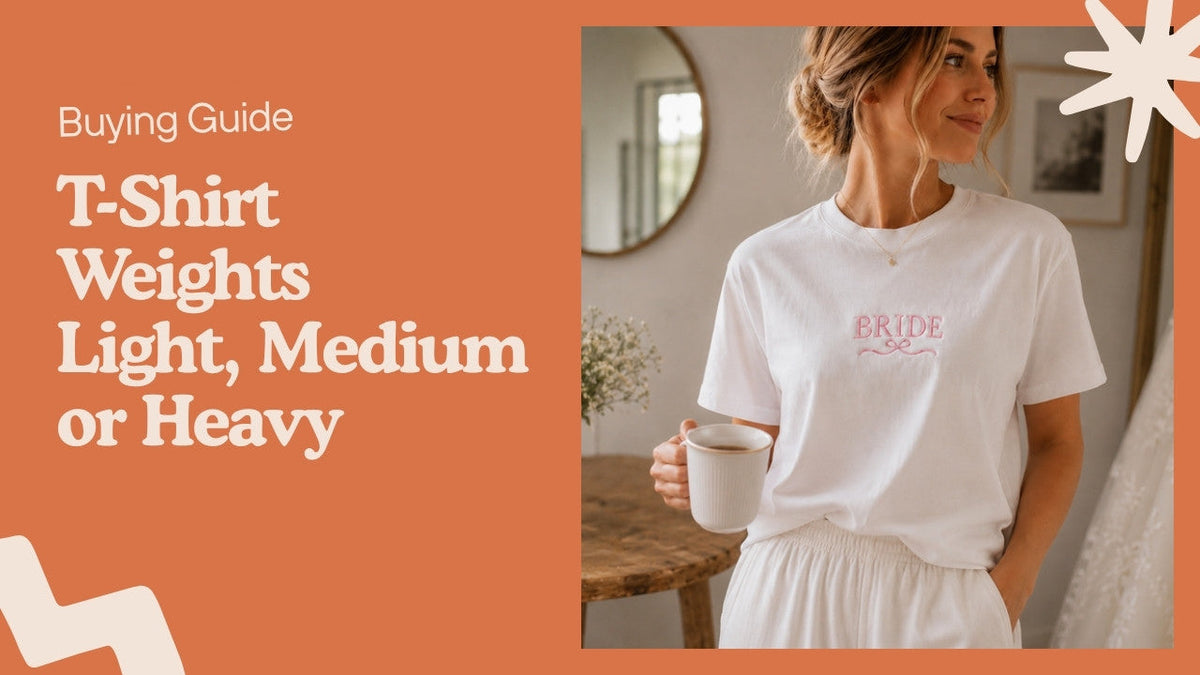
Our sweatshirts are heavyweight cotton and fleece. For a tee, a short word works well, like the Bow Bride embroidered t-shirt with five letters and a small bow. More options are in our embroidered t-shirts collection.

For a side-by-side look at how stitched and printed designs age, read embroidery vs screen printing.
How to pick the right weight for a custom shirt order
Use these steps when you are ordering shirts for a team, an event, or a gift and have to commit to one blank.
- Decide where the shirt will be worn. Outdoor summer events lean light, while cold offices and fall games lean heavy.
- Check the decoration. Large prints or dense embroidery need at least a medium weight fabric.
- Look at the color. White, cream, and pastel shirts below 4.5 oz may show what is underneath.
- Read the unit. Confirm whether the figure is oz/yd², linear ounces, or GSM before comparing two blanks.
- Hold a sample if you can. Five minutes with a real shirt answers more than any spec sheet.
- Check the size chart last. Heavier fabric drapes differently, so a fit you know in one weight may feel boxier in another.
Mistakes when choosing a shirt weight
These come up most with first-time custom orders and gift purchases.
Comparing numbers in different units is the classic one. A 180 GSM shirt and a 5.3 oz shirt are nearly the same fabric, yet the first looks far heavier on paper.
Sizing up to get a heavier, oversized look is another. Our shirts already have a relaxed cut, so if you sit between two sizes, go up one and stop there.
Then there is the person who orders a thin white tee for an outdoor photo. Sunlight goes straight through it. A medium weight shirt in the same color fixes that.
Caring for heavier embroidered shirts
Read this once you own a heavy tee or sweatshirt with stitching on it and want it to last past the first season.
Turn the shirt inside out, wash it cold on a gentle cycle, and tumble dry low or hang it. Our fabric is pre-shrunk and shrinks less than 5% when washed cold. Skip bleach and fabric softener, and never iron straight onto the embroidery.
Fold sweatshirts instead of hanging them, because a heavy body stretches the shoulders on a hanger. Our guide on how to wash embroidered clothing has the full routine.

The I Come From A Long Line Of People sweatshirt is a good example of a heavy crewneck carrying four full lines of thread. Browse the rest in embroidered hoodies and sweatshirts, or compare fabrics in our hoodie material guide.
FAQ
How much does a t-shirt weigh in grams?
Most adult t-shirts weigh between 140 and 200 grams. Small lightweight tees can be under 100 grams, and large heavyweight ones can pass 280 grams.
How much does a shirt weigh for shipping?
Plan on about 6 ounces for a standard adult tee and add the mailer. At Me Do Embroidery, shipping is priced per item, $6 for the first and $5 for each extra, and free from 3 items.
Is 5.3 oz a heavyweight t-shirt?
No, 5.3 oz per square yard is medium weight. Heavyweight usually starts around 5.5 to 6 oz.
What GSM is a heavyweight t-shirt?
Heavyweight tees usually start around 185 to 200 GSM. Many streetwear blanks run 220 GSM or more.
Does a heavier t-shirt shrink less?
Shrinkage depends more on whether the fabric was pre-shrunk than on its weight. Pre-shrunk cotton, like ours, shrinks less than 5% in a cold wash.
Which t-shirt weight is best for embroidery?
Medium weight and heavyweight fabrics hold embroidery with less puckering. Lightweight tees work for small, light designs stitched over a stabilizer.