A team jersey for gaming gets judged in two very different places. One is a webcam frame about an arm's length from the player.
The other is the back row of a school gym, where a fan in your colors hopes to be spotted on the broadcast. Most custom esports jerseys are designed only for the first place. The second gets forgotten until someone asks, "Can I buy one too?"
To design custom esports jerseys, pick a two- or three-color palette with a dark base and plan where every logo sits. Size each gamertag for the longest name on the roster, and order sublimated polyester so the colors are dyed into the fabric. Then make a fan version without player names, and leave time for proofs, sizing and shipping.
What makes a custom esports jersey different
This section is for team captains, club advisors and anyone ordering a jersey for gaming for the first time. It explains why a soccer-style template rarely works on stream.
A traditional sports jersey is read from the stands. Big numbers, flat team colors and a surname across the shoulders are enough at that distance.
An esports kit is read through a camera, often compressed into a small video window next to the game feed. Fine lines turn to mush and pale colors wash out under stage lights. A logo that looks huge on a mockup can shrink to a smudge in a 300-pixel facecam.
Players also sit for a long time. A LAN day can run from morning check-in to the last bracket at night. A light, breathable fabric matters more than a heavy one. And the back of the shirt carries a gamertag instead of a legal name, which changes how you plan spacing.
Sponsors are the last difference. Even a small amateur squad may want a Discord server icon, a local café that paid for entry fees, or a school crest. Room for those marks has to be planned on day one.
How to design custom esports jerseys step by step
Use these steps if you are building the design yourself, before you send anything to a printer. Doing them in order saves you from redrawing the layout when a sponsor shows up late.
- Write a one-paragraph brief. Note the team name, the games you play, the event dates, roster size, and who has the final say. Teams without a decision-maker tend to stall at the color stage.
- Choose your palette. A dark base (black, charcoal or deep navy), one or two saturated accent colors, and white for text is a safe starting point. Save the exact hex codes so every file uses the same shades.
- Sketch the placement zones. Mark the chest, both sleeves, the upper back, the lower back and the collar. Give the team logo the center chest, then decide what goes where in order of importance.
- Collect logos as vector files. SVG, AI or a high-resolution PNG with a transparent background will print cleanly. A screenshot of a Twitter avatar will not.
- Build the pattern last. Gradients, angular shapes and stripes should sit behind the logos, not compete with them. Keep busy patterns out of the area where text goes.
- Set up the gamertag template. Measure it with the longest handle on your roster, then check how the shortest one looks in the same box.
- Test at thumbnail size. Shrink the mockup to the size of a facecam on a 1080p stream. If the team name is unreadable there, raise the contrast or enlarge it.
- Get a written proof for every player. Read every name letter by letter, including numbers and capitals, before you approve production.
Colors that hold up on camera
High contrast does most of the work. White or bright yellow text on black survives video compression far better than gray on navy. Mid-tone saturated colors like teal, electric blue or orange read well on stream, while pastels can flatten into one beige shape under stage lights.
Placing the gamertag
Put the handle across the upper back, with a number underneath if your team uses them. Some teams add a smaller handle on the front chest so players are identifiable in interviews and on a desk cam. Keep the font simple. A stylized gaming font that looks great with "Zeta" can become unreadable with "xX_N1ghtOwl_Xx".
How to choose an esports jersey maker
Read this before you request quotes. The right esports jersey maker for a five-player squad may be wrong for a 40-player college program. Compare them on the same questions.
- Which decoration method do they use for full-color designs? Dye sublimation on polyester is the usual answer for edge-to-edge gradients.
- Is there a minimum order, and does the price per jersey drop at certain quantities?
- Can each player have a different name and number in one order, without extra setup fees?
- Will you see a proof of every individual jersey, or only one sample layout?
- How do players submit sizes? A group order link beats a spreadsheet passed around a Discord channel.
- What is the turnaround in business days, and does it include production time or only shipping?
- Do they offer a youth or women's cut for mixed rosters?
- What happens if a name prints wrong? Ask whether they reprint, and whether you have to send the bad jersey back first.
- Can you reorder the same design later for a new player without paying setup again?
Ask for a fabric sample if the budget allows. Mesh weight and stretch vary a lot between suppliers, and players who sit for ten hours will notice.
Using an esports jersey creator tool without wasting a weekend
An online esports jersey creator is a good fit for small teams with no designer. It lets you drop logos on a template, try colors and preview names before you pay.
Open the tool only after the brief and palette are settled. Otherwise you will spend hours clicking through templates that do not match your team. Upload vector logos first, then add text, then patterns. Most creators let you save a design link, so share it with the team and collect comments in one thread instead of five.
Watch for two traps. The first is preview lighting: a screen mockup on a white background looks brighter than the real fabric will. The second is the sleeve. Logos placed near the seam can wrap around and get cut off, so keep them a little inside the guide lines the tool shows.
Custom gaming jerseys for different kinds of teams
Each kind of team orders custom gaming jerseys for a different reason. Find yours below and adjust the plan.
College and high school varsity programs
School programs often field several games at once, so one jersey design may need to cover 15 or more players across titles. Check school branding rules early. Many athletic departments control how the official logo and colors can be used, and approval can take longer than the printing.
Discord groups and friend squads
A group of six friends usually wants a jersey that feels like an inside joke. Keep the main design clean and put the joke somewhere small, like the collar or the hem. You will still be happy wearing it in a year.
Amateur teams with local sponsors
A sponsor who paid for travel will expect to see their logo on stream. Agree on placement and size in writing before you design. Leave one spare zone on the sleeve in case a second sponsor joins mid-season.
Streamers and content teams
Here the jersey is mostly seen on camera from the chest up. Put the brand on the chest and shoulders, and skip detailed back designs that nobody will ever see on stream.
Coaches, managers and analysts
Staff should match the team without being mistaken for a player. A polo or hoodie in the team palette with "Coach" on the back often works better than a full player kit.
Fan gear and esports jersey ideas for supporters
This part is for teams that want fans, parents and classmates to wear the colors too. Fan gear makes a crowd show up on camera and can help cover travel costs if you sell it.
- A fan edition of the jersey with the same front and an empty back, so supporters are not wearing a player's handle.
- "Player 2" or "Support" printed where the gamertag would go, for parents and partners who come to every event.
- Number-only backs using the year the team was founded.
- Sleeve patches listing the tournaments the team has entered, updated each season.
- Scarves in team colors, borrowed from soccer culture and easy to hold up for the camera.
- Caps with the team logo stitched on the front, for fans who do not wear jerseys.
- Heavy hoodies in the dark base color with only a small chest logo, so they work as everyday clothes.
- Matching lanyards for event badges.
- Tote bags for carrying a controller, headset and snacks into a venue.
- Team-color wristbands for crowd shots.
- Limited "first season" shirts with a date on the hem, sold only once.
- Name-and-handle hoodies for alumni players, so former roster members still feel part of the club.
Keep fan pieces cheaper and simpler than the player kit. People buy them to belong, so a recognizable logo matters more than full sublimated graphics.
Where embroidered gear fits next to the jersey
Read this if your team wants clothes for travel days, waiting rooms and cold venues.
To be clear, Me Do Embroidery does not make esports jerseys. We only do embroidery. Stitching a dense logo onto thin polyester mesh is a poor match, because the fabric can pucker. Jerseys are a job for sublimation.
Embroidery belongs on the heavier pieces around the jersey.
Our embroidered hoodies and sweatshirts are heavyweight cotton and fleece in a relaxed fit. We stitch them with French DMC thread that does not fade or bleed. That is the hoodie a player pulls on between matches when the air conditioning is set too low. For a crowd that dresses in black, a plain dark sweatshirt with white stitched text fits right in.

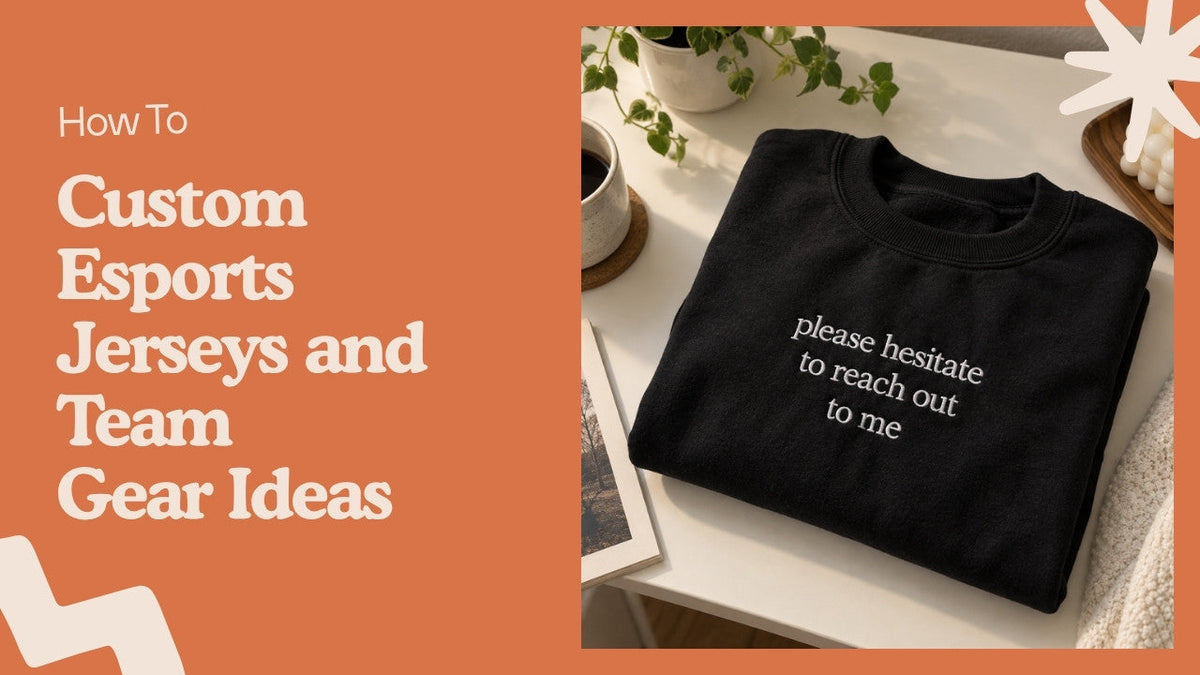
Our Please Hesitate To Reach Out To Me sweatshirt suits the teammate who goes quiet on Discord before a big match. Caps are another simple option. Our embroidered hats and caps collection uses cotton twill with an adjustable strap for heads around 21 to 24 inches. That solves the "nobody knows anyone's size" problem for fans.
Every piece is made to order and arrives in 3 to 7 business days, including production. Shipping is free from three items, so a small group can split one order. If you want to compare how stitching and print hold up over time, read our guide on embroidery vs screen printing.
Mistakes to avoid when ordering for a whole roster
These come up for first-time organizers. Each one costs either money or a reprint.
Collecting sizes late is the most common. Players guess, then trade jerseys at the venue. Send the size form the same day you approve the design, with a size chart attached.
Spelling errors are next. A handle like "Rhyno" will be "corrected" to "Rhino" by somebody along the way. Ask each player to type their own handle, and paste it rather than retype it. Personalized items are often non-returnable, including ours in the personalized embroidered gifts collection, so a typo is your cost.
Ordering exactly one jersey per player leaves no room for a mid-season sub. One or two extra in common sizes is cheaper than a separate small reorder.
Timing is the last trap. Count backward from the event: shipping, production, proof approval, and at least a few days for the team to argue about colors. If any piece of the order is made to order, ask whether the quoted time is business days or calendar days.
After the event, wash team gear inside out in cold water. Our guide on washing embroidered clothing covers the hoodies and caps, and most sublimated jerseys follow similar rules. For step-by-step help placing a group embroidery order, see how to order custom embroidered merch.
Custom esports jerseys FAQ
What is the best printing method for custom esports jerseys?
Dye sublimation on polyester is the standard for custom esports jerseys. It handles gradients, full-coverage patterns and many logos without the ink cracking or adding weight.
What should I look for in an esports jersey maker?
Look for an esports jersey maker that offers individual names in one order and a proof for every jersey. The turnaround should be stated in business days. Also ask what they do if a name prints wrong.
Can I put gamertags on the back instead of real names?
Yes. Most jersey makers treat a gamertag as normal custom text, so it can include numbers and mixed capitals. Size the text for the longest handle on the roster.
How far ahead should a team order jerseys before a tournament?
Plan for several weeks, because design approval and size collection take longer than most teams expect. Check whether your supplier's quoted time includes production or only shipping.
What can fans wear if they don't want a full jersey?
Caps, scarves and dark hoodies with a small team logo work well for fans. A fan edition of the jersey with a blank back is another option.
Can you embroider an esports jersey?
You can, but thin polyester mesh tends to pucker under dense stitching. Embroidery suits hoodies, caps and jackets worn alongside the jersey better.