Cotton that weighs twice as much at mile three is not a bad shirt. It is a good shirt doing the wrong job. Plenty of disappointing team orders start there, with fabric chosen for how it looked on a product page. This performance shirt guide helps you make the call before paying for forty custom dri fit shirts.
Performance shirts are tees made from synthetic fiber, usually polyester or a polyester blend. They pull sweat off the skin to the outside of the fabric, where it dries. Pick 100% polyester for heat and hard effort, and a blend if people will wear it again on a normal day. Cotton only makes sense when nobody is going to sweat.
We should say upfront who is writing this. Me Do Embroidery stitches sweatshirts, hats and a small run of t-shirts to order in the USA, and we do not sell performance tees.
We do spend our days putting thread into fabric, though. Whether a custom athletic shirt still looks good after twenty washes often depends on how decoration and fabric get along. That part we know well, and it is where most guides go quiet.
What is a dri fit t shirt, and what "performance" means on a tag
This section is for anyone who has seen "dri fit," "dry fit" and "moisture-wicking" on three product pages. Do they mean the same thing? Mostly, yes.
Dri-FIT is a Nike trademark. It names Nike's own moisture-wicking polyester, and only Nike can print it on a label. The name became so familiar that people now type "dri fit" for any sweat-wicking athletic tee. Other spellings show up too, like dry fit, dryfit and drifit.
Searches for custom dryfit shirts or drifit custom t shirts point at one product: a lightweight polyester tee you can put a logo on.
Other brands use their own trademarked names for the same idea. The mechanism doesn't change from label to label. Cotton fiber soaks up water and holds it, so the shirt gets heavy and clings. Polyester fiber barely absorbs water, and performance knits are built so sweat spreads along the yarn to the surface, where air dries it.
"Performance" on a tag is a looser word. It can cover any of these features, alone or together:
- Moisture-wicking knit, the one feature nearly every performance tee has.
- Sun protection with a UPF rating. UPF 50 lets through about one fiftieth of the sun's UV.
- Anti-odor treatment, useful because polyester tends to hold body odor longer than cotton.
- Stretch from added spandex, common in fitted and women's cuts.
- Tag-free neck labels, which seem minor until an hour into a run.
So what is a performance tee? The short answer is a wicking synthetic tee. The useful answer is to check which extras a given shirt includes. Two "performance" shirts at the same price can be very different garments.
Fabrics for custom athletic shirts, from polyester to tri-blend
Read this before you choose a style. Fabric drives comfort, price and the decoration methods you can use, and it decides whether anyone wears the shirt after the event.
100% polyester
Full polyester suits heat, long efforts and outdoor work. It dries fastest, keeps its shape and barely shrinks. It is also the only base that takes dye sublimation well, which matters for all-over prints.
The trade-offs are real. Pure polyester can feel slick or plasticky to people used to cotton, and cheaper versions pill. It also holds onto smell. A team training in the same shirts three times a week will notice.
Poly-cotton blends and tri-blends
Blends mix polyester with cotton, while tri-blends add rayon for a softer drape. They wick less than full polyester and dry slower, but they feel close to a favorite old tee.
That softness is why blends get worn again. When a charity walk shirt ends up in someone's weekend rotation, your logo stays in public for years. Slick race-day polyester often goes into a drawer once the medal comes home.
Custom dry fit t shirts vs. regular cotton tees
Cotton still has a place. It is cheaper, takes almost every print method and feels good when you are standing around. For a company picnic in the shade, cotton is fine.
Choose the dry fit version once people will move hard, work in sun or sweat for hours. Nobody forgives a soaked cotton shirt in July.
Here is a rough rule we like. If the event has a start time and a finish line, go synthetic. If it has a buffet and lawn chairs, cotton or a soft blend works. Anything in between usually lands on a blend.
How to read a fabric tag before you order in bulk
This part is for whoever places the order. Product pages can be vague, and one sample costs much less than a box of wrong shirts.
- Find the fiber content. "100% polyester" and "65/35 poly/cotton" behave very differently, even when both are sold as performance.
- Check the fabric weight, usually listed in ounces. Lighter means cooler and more see-through.
- Look for the knit type. Interlock feels smoother and more opaque, while mesh breathes more and shows more skin.
- Note any spandex. Stretch helps fit but makes some print and stitch methods harder.
- Do the water test on a sample. Put a few drops on the inside and watch.
- Wash that sample once, cold, and dry it low. Then check for shrinking, twisted side seams and pilling.
On a wicking knit, the drop spreads out and starts to fade. On cotton it soaks in and stays as a dark spot.
Ten minutes with one sample answers most questions a product page leaves open.
Colors, necklines and sleeves for team performance tees
Organizers who already know the fabric can use this section to settle the smaller choices. They seem cosmetic, yet they change how the shirt feels in heat.
Color
Light colors reflect more sunlight, so white, silver and pale gray feel cooler outdoors. They also show sweat lines and grass stains. Darker shades hide both but soak up heat in direct sun. Heathered colors are a decent middle ground, since the mixed yarn breaks up sweat marks without going fully dark.
Keep in mind that sublimation needs a light base. A heather or dark choice rules it out.
Safety matters for early-morning runs and roadside crews. Neon yellow, orange and lime are easy for drivers to spot. Some work sites require high-visibility colors, so check before you choose.
Neckline
Crew necks are the default and suit most bodies. V-necks feel cooler and are popular in women's cuts. Mock and quarter-zip necks belong to cold-weather layers rather than summer tees.
Sleeves
Short sleeves cover most events. Sleeveless and tank cuts help in gyms, volleyball and hot track meets. Long sleeves protect arms from sun, which outdoor crews often prefer over sunscreen.
Raglan sleeves, the kind with a diagonal seam from collar to underarm, give more shoulder movement and look a bit more athletic. If you plan a sleeve print, check where that seam falls first.
Custom performance shirts by use case
Use this list to match fabric and decoration to the people wearing the shirts. Each group has its own problem to solve.
- 5K and charity run teams: mixed groups are the norm, with a few serious runners, many walkers and some kids. Soft blends keep the casual crowd happy. Runners will survive a slower dry time over 3.1 miles.
- Half marathon and relay squads: hours of effort change the math, so go 100% polyester. Ask about flat seams and tag-free labels, since chafing shows up around mile eight.
- Landscaping, roofing and outdoor crews: custom dri fit apparel with a UPF rating earns its price here. Pick a darker color that hides dirt. Make sure the design reads from across a yard.
- Company field days: these shirts often double as dri fit company shirts for casual Fridays. Brand-color blends with a small logo get worn far more than giant front prints.
- Summer camp staff: counselors wash the same two or three shirts constantly. Durability beats softness, so choose full polyester with a screen print or sublimation.
- Rec league teams: softball, kickball and volleyball players want names and numbers. Look for a supplier that adds individual names in one order instead of ten.
- Gym and CrossFit groups: sleeveless and muscle cuts are popular. Big back prints move with the body, so keep text away from side seams where it will crack or stretch.
- Fall and early-morning races: long sleeves help when the start line is cold. A men's moisture wicking performance t-shirt in long-sleeve with a custom print down the sleeve adds room for a sponsor.
- Coaches and event staff: they need to look in charge, not like they ran the race. Polo-style knits or crew tees with a stitched chest logo read more official than a loud event print.
Sizing a mixed team
Mixed-gender teams often ask whether one unisex style is enough. It can be. Unisex cuts tend to fit like men's sizes, though, and women often size down and still find the shoulders wide.
If the budget allows, order men's and women's versions of the same style in one color. Most performance lines come in matched pairs for this reason.
Athletic and regular fits also differ. Athletic cuts sit closer to the body with tapered sides. Regular fits hang straighter and suit groups with mixed body types better. When in doubt, let each person choose on the size form.
Hats and accessories for race day
Accessories stretch an event budget further than people expect. Stitched caps keep sun off the face during the race and get worn on regular days long after the shirt is retired.
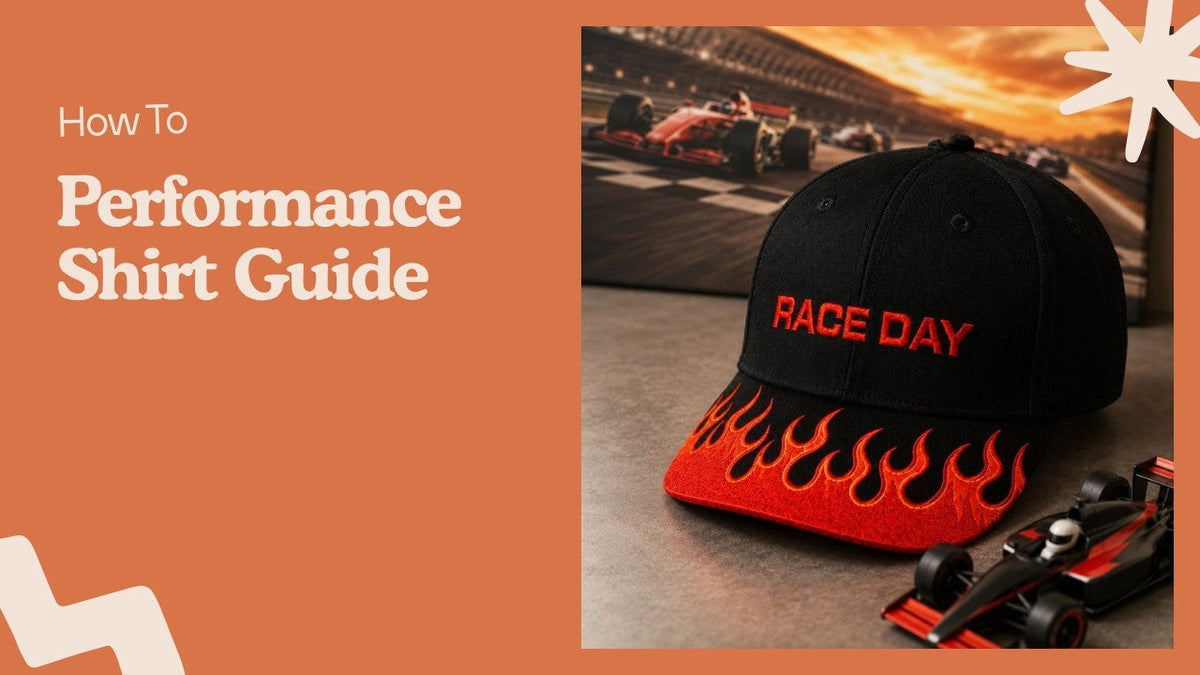
That is why our Race Day embroidered flame hat sells to people who never pin on a bib. Our caps are cotton twill with an adjustable closure. They fit heads around 21 to 24 inches, so you don't need anyone's size.

Dri fit t shirt printing and embroidery, method by method
This section is for anyone choosing how the logo goes on. Polyester reacts to heat and ink differently than cotton does, so your usual method for cotton tees is not always right here.
Screen printing
Screen printing is the standard for bulk orders with a few spot colors. It is durable and cheap per shirt once quantity climbs.
On polyester, the printer has to manage dye migration. Heat during curing can pull the fabric's own dye up into the ink, and white logos on red shirts turn pinkish. Good shops use low-bleed inks and lower cure temperatures for synthetics. Ask whether yours does before ordering red, maroon or other strongly dyed colors.
Dye sublimation
Sublimation turns ink into a gas that bonds with polyester fibers. The print has no feel and will not crack, because it sits inside the fiber. The catch: it only works on white or very light fabric with high polyester content.
For full-color, edge-to-edge designs on a light shirt, sublimation is the best route. On a navy blend it is useless.
Heat transfer and DTF
Heat transfer vinyl and direct-to-film prints are pressed on with heat. They handle small runs, individual names and full-color logos on dark polyester. The press temperature must stay low to avoid scorching or dye migration. These prints sit on the surface, so large designs can stiffen a thin shirt.
Direct-to-garment
DTG printing works best on cotton. On full polyester the colors tend to look dull and wash out faster, so ask for a sample wash before a team order.
Quick match between order type and method
- Fifty or more shirts with a one- or two-color logo: screen printing with low-bleed ink.
- White race shirts covered edge to edge in color: sublimation.
- Rosters needing individual names and numbers: heat transfer or DTF layered over a shared design.
- Staff and coaches who need to look polished: a small stitched chest logo.
- One shirt for yourself or a short test run: DTF or embroidery, since neither needs screens.
Mixing methods on one order is normal. Plenty of teams print the front and add names by heat transfer on the back.
Embroidery on thin performance fabric
Embroidery is where we can speak from the machine side. Thread looks sharp and will not crack or peel the way prints can after many washes. Our comparison of embroidery and screen printing over time covers that in detail.
On lightweight knits, stitching needs more care than on a heavy sweatshirt. Thin, stretchy fabric puckers. Thousands of needle punches pull the knit inward, leaving ripples around the logo. Every design we stitch has a stabilizer layer on the back to keep it flat, and on light knits that backing matters even more.
Soft, thin backing suits performance tees. Stiff backing makes a hard patch against the skin.
Density matters too. Designs built for thick hoodies can carry too many stitches for a 4-ounce tee. That is why we test-run new designs on scrap fabric and adjust density first. Our explainer on what stitch count means shows why more stitches are not always better.
For a custom logo on a moisture-wicking performance tee, keep it small and on the left chest so most of the shirt still breathes. Big solid-fill back designs become thick, non-wicking panels right where people sweat most.
Want both? Put the large artwork in print and the small logo in thread.
Thread choice matters on gear that gets washed every week. Polyester embroidery thread handles harsh detergents and sun well, which suits work uniforms. Cotton and rayon threads look softer and have more sheen, though they need gentler care.
Our caps and sweatshirts use French DMC thread that holds color and does not bleed into the fabric. Whatever thread a shop uses, ask how it handles hot washes and bleach if your team gear will see either.

You can see the scale on our Bow Bride embroidered t-shirt. The stitched area is small and centered, and the rest of the shirt stays soft. It is made for a wedding morning, not a race, but the placement logic carries over to any team tee.
How to order custom dri fit shirts, step by step
Follow these steps if you coordinate a team, club or company order. They run in the order that saves the most rework.
- Lock the date first. Count back from the event, leaving room for a proof round, production, shipping and size swaps.
- Decide the use: one race, a season of games or daily work wear. That answer picks your fabric.
- Choose the decoration method to match fabric and color, using the method section above.
- Prepare the artwork as a vector file (AI, EPS, SVG or high-resolution PDF) if you have one. Blurry website logos look blurry on fabric too.
- Collect sizes with a form where each person enters their own. Guessing for other adults causes most returns.
- Review the proof slowly for spelling, date, colors and placement. Then have someone who didn't write the text check it.
- Order two or three extras for late sign-ups and torn shirts. Spares usually cost less than a rush reorder.
Dri fit shirt design tips that hold up
Custom design dri fit t shirts work best when the design respects the fabric. Keep large solid blocks of ink or thread to a minimum, since they cut breathability and add weight.
Leave a margin from side seams and armholes. On heathered fabric, make thin lines thick enough to survive the texture. Choose colors with real contrast, because dark gray on navy disappears beyond a few feet. Simple artwork also costs less to set up for print or stitch.
Using a design tool for customizable dri fit shirts? Zoom to actual size before you approve. Text that looks fine on a big screen can be unreadable at three inches wide.
For stitched merch in particular, we wrote a separate step-by-step guide to ordering custom embroidered merch.
Budget and timeline for a group order
This section helps whoever holds the budget. Performance shirts cost more per piece than basic cotton, so the way you order affects the total more than usual.
Quantity is the biggest lever. Most suppliers lower the per-shirt price at set tiers, so check where the breaks fall. Ordering 50 instead of 46 can cost about the same in total. The four extra shirts then become your spares.
Setup costs depend on the method. Screen printing usually charges per color, since every color needs its own screen. Cutting a five-color logo down to two can save real money on a mid-size order. The simpler version often reads better from a distance anyway.
Embroidery pricing tends to follow stitch count. Shops often charge once to digitize a logo, which means converting artwork into a stitch file. Reorders reuse that file, so the second batch usually costs less to set up.
Timelines vary just as much. Standard production at large printers often takes one to two weeks before shipping. Rush options exist, but they cost extra and limit your fabric choices.
Collecting money is its own small project. Some organizers pay up front and get reimbursed, which works for a handful of friends. For a club of thirty, ask each person to pay when they submit their size, so nobody chases payments after the shirts arrive.
Plan backwards from the event date and add a week of slack. That covers a proof change, a missed size and a slow delivery without anyone panicking.
Mistakes that ruin a team shirt order
First-time organizers run into most of these. Some catch experienced buyers too.
- Choosing very light white polyester for runners. It goes see-through when wet.
- Putting a huge front print on a shirt meant for heat, then wondering why nobody wears it again.
- Assuming a unisex medium fits everyone who wears a women's medium elsewhere.
- Picking thread or ink close to the shirt color. Up close it looks subtle; from the sidelines it vanishes.
- Ignoring dye migration on red or maroon shirts with white logos.
- Approving a low-resolution logo on a phone screen.
- Ordering so late that the only option is whatever fabric is in stock.
- Printing the year on gear for a group that meets all year.
That last one deserves a second look. Put the team name on, leave the year off, and you get a shirt you can reorder next season without a new setup.
When a performance shirt is the wrong pick
Read this if your event is not really athletic, or if you want something people keep for years. Synthetic tees solve a heat-and-sweat problem. Without that problem, better options exist.
Cold-weather events are the obvious case. November turkey trot crowds care more about warmth at the start than wicking at the finish.
Post-race gifts are another. Finishers already holding a polyester tee will value something cozy more than a second one. Teams wanting a keepsake, such as a first marathon group or a club marking ten years, usually get more use from a heavy sweatshirt. It comes out every cold morning instead of once a year.
This is where we sit. Our embroidered sweatshirts and hoodies are heavyweight cotton and fleece in a relaxed fit. We stitch them with French DMC thread that does not fade or bleed.
Each one is made to order. Production plus shipping takes 3 to 7 business days in total. That works for an end-of-season gift if you plan ahead, but not for a race this weekend.

Our designs lean funny and sarcastic. Coaches who argue every call might deserve our Sorry About the Things I Said When I Was Right sweatshirt more than another polo.
For lighter pieces, our embroidered t-shirts and embroidered baseball hats sit between gym gear and everyday wear.
Caring for performance shirts so they keep wicking
These rules are for anyone who wants a tee to work in its third season like it did on day one. Polyester is tough, but a few habits break it down faster than wear does.
- Skip fabric softener and dryer sheets. They coat synthetic fibers, block wicking and build up over time.
- Wash cold, inside out, on a gentle cycle. Turning the shirt protects prints and stitching from rubbing.
- Dry low or hang dry. Polyester dries fast anyway, and high heat causes pilling and print damage.
- For lingering smell, soak in cold water with some white vinegar before washing.
- Never iron directly on a print or on stitching. Polyester can melt or go shiny, and stitched areas pucker.
- Wash sweaty shirts soon. Leaving one damp in a gym bag overnight is how odor sets in.
Embroidered pieces follow the same cold-and-gentle logic. Our notes on washing embroidered clothing without ruining it cover folding, storage and spot cleaning.
Performance shirt FAQ
What is a dri fit t shirt?
It is a lightweight polyester or polyester-blend tee that moves sweat to the outside of the fabric so it dries fast. "Dri-FIT" is Nike's trademark, but people use it for any wicking athletic tee.
What is a performance tee?
Performance tees are t-shirts made from synthetic fabric built for activity, with moisture-wicking as the core feature. Many add sun protection, anti-odor treatment or stretch.
Can I order custom dri-fit shirts with no minimum?
Yes, many suppliers sell single custom performance shirts, usually decorated by heat transfer, DTF or embroidery. Per-shirt prices are higher for one piece and drop as quantities rise.
Which printing method lasts longest on polyester?
Dye sublimation lasts longest on white or light polyester because the ink becomes part of the fiber. On dark polyester, low-bleed screen printing or a stitched logo is the durable choice.
Can you embroider on a moisture-wicking shirt?
Yes, if the design is small, the stitch density suits thin fabric and soft stabilizer backs the stitching. Left-chest logos work better than large solid designs, which block airflow.
Do performance shirts shrink in the wash?
Full polyester shirts barely shrink. Blends with cotton can shrink slightly, so wash them cold and dry on low heat.