The first time a team manager gets a uniform quote, one word tends to stop them cold. The line item says "sublimated" next to a price. Nobody in the parent group chat can say whether that's the premium option or the shortcut. This guide to sublimated jerseys is for that person, whether it's a coach, a league volunteer or the captain of a Thursday rec team.
Sublimated jerseys are polyester jerseys with the colors, logos, names and numbers dyed into the fabric by heat. Nothing is printed on top. Because the ink becomes part of the fibers, there's no layer to crack or peel, and the design can cover the whole garment. The trade-off is that the method only works well on polyester, usually light-colored polyester.
What is a sublimated jersey? Meaning and definition
If you need to define sublimated jerseys quickly for a parent meeting, this section is enough. A sublimated jersey is a sports top decorated by dye sublimation. In that process, special ink turns into a gas under heat and bonds with polyester fibers.
The word comes from chemistry. Sublimation means a solid turning straight into a gas, skipping the liquid stage. Dry ice does it at room temperature, and sublimation ink does it inside a heat press.
So the sublimation jersey meaning is simple: a jersey where the dye entered the fabric as a gas. You will see the same product sold under other names:
- Dye-sub jerseys, the shorthand most decorators use.
- Full-dye or full-sublimation uniforms, which stresses that the whole garment is colored.
- All-over print, a retail term that sometimes covers other methods too, so ask.
Run your hand over one and you'll notice the giveaway. The numbers feel exactly like the rest of the shirt. No raised edge, no rubbery patch, no stitching.
How a sublimation jersey is made, step by step
This part helps when you're comparing two quotes and want to know what you're paying for. Sublimation printing on a jersey happens in five stages, and the order matters.
- The designer lays your artwork onto flat pattern pieces: front, back, sleeves, sometimes the collar. Each player's name and number goes on their own back panel.
- A printer loaded with sublimation ink prints those panels onto transfer paper, mirrored, so they read correctly once flipped.
- Each sheet goes face down on white polyester fabric inside a heat press, commonly set around 400°F.
- Under that heat the ink turns to gas while the polyester fibers open up. When the fabric cools, the fibers close around the color.
- Workers cut out the printed panels and sew them into finished jerseys.
Why it has to be polyester
Sublimation dye bonds with polyester and other synthetics. Cotton fibers don't hold it, so a cotton shirt looks washed out from the start and keeps fading in the laundry. Blends land in between: the more cotton, the paler the result. That's why nearly every sublimated jersey is a light, moisture-wicking polyester knit.
Cut-and-sew vs pressing a finished jersey
Some shops skip the last step and press a design onto a jersey that's already sewn. It costs less to set up. But the press can't reach under seams or around the armpits, and folds leave white streaks where the dye never landed.
If a quote promises edge-to-edge color, ask whether the panels are printed before sewing. That one question explains a lot of the price gap between two "sublimated" offers.
Sublimated jerseys vs screen print, heat transfer and stitched lettering
Read this if your league lets you choose the decoration and you want a neutral comparison. Each method wins somewhere.
- Dye sublimation gives unlimited colors, gradients and photos at no extra cost per color. Nothing can peel. It needs polyester, and the base fabric is usually white or light because dye can't lighten a dark fabric.
- Screen printing lays thick, opaque ink on top of cotton or poly. It's cheap per piece on big orders with few colors. Each added color needs another screen, and the ink can crack after many washes. We compared print and thread over time in embroidery vs screen printing and which lasts longer.
- Heat transfer vinyl means cut letters pressed onto a finished jersey. Leagues often use it to add names and numbers to stock uniforms. It's fast for small runs, though edges can lift after a season of hot dryers.
- Tackle twill and embroidery use fabric letters or thread sewn into the garment. They're heavy, classic and the most textured option, great on hoodies and warmups. On a game jersey in July, that weight is exactly why teams moved to sublimation.
What are sublimated uniforms good for, and when to skip them
This is for teams deciding between a full sublimated kit and a simpler printed set. The method suits some sports far better than others.
Sublimation pays off in hot, high-sweat sports like soccer, basketball, volleyball and lacrosse. There, an extra layer of ink or vinyl traps heat. Busy designs are another fit: a sponsor logo on the sleeve, a side pattern, a gradient from shoulder to hem. Esports and streaming teams like it for the same reason, since their designs tend to be loud.
It's a weaker choice in three cases. First, players who want a cotton feel for warmups or travel won't get it. Second, a mid-season roster change is awkward, because a new name can't join the original print run.
Third, a dark jersey that's already sewn can't get white lettering by sublimation. The method only adds color, so light lettering has to be planned in the panels before sewing.
Mistakes to avoid when ordering for a whole team
Most trouble with team orders happens before anything is printed. These checks are worth doing before you approve a proof.
- A logo copied from a social media profile looks fine on a phone and blurry across a jersey front. Send the original vector file (.ai, .eps, .svg) or a high-resolution PDF.
- Your monitor glows; fabric doesn't. Navy can print close to black and neon tones lose punch. If the team color matters, ask for a printed swatch or a Pantone match.
- Collect names in a spreadsheet, not a group chat. Then have each player or parent confirm their own line. Two kids both promised number 10 is a classic first-game argument.
- Athletic cuts run slimmer than everyday tees. Ask whether the decorator offers a size kit, and measure the youngest players, since they grow between ordering and opening day.
- Custom panels are printed and sewn per order. Work back from the first game and leave room for one round of corrections.
How to wash dye sublimation jerseys
Parents doing laundry after every game will get the most out of this part. Dye sublimation jerseys are easy to care for, but heat and harsh chemicals still shorten their life.
Turn the jersey inside out and wash it cold with similar colors. Skip bleach. Skip fabric softener too, since it coats polyester and makes wicking fabric hold sweat.
Hang it to dry or tumble on low. A hot dryer won't make the design peel, because nothing is there to peel. High heat can still soften polyester and slowly dull the color, so don't iron over a printed area either.
Wash it the day of the game. A sweaty jersey left balled up in a bag overnight is how the smell sets in.
What parents, coaches and fans wear on the sideline
Sublimation is built for the people on the field. The bleachers are full of cotton, fleece and caps instead. That's where stitched decoration does well, because thread works on cotton and holds up to years of washing.
That's our corner of this. We're an embroidery shop, so we don't make jerseys. We stitch every sweatshirt, hat and tote to order in the USA with French DMC thread. Each new design runs on scrap fabric first, so we can set the stitch density before it touches a garment.
A cap is an easy pick for a coach or a race-day crowd, since one adjustable size fits most heads. This Race Day embroidered flame hat is one example, and our embroidered hats and caps cover more styles. For a team logo, we wrote up where to get hats embroidered.

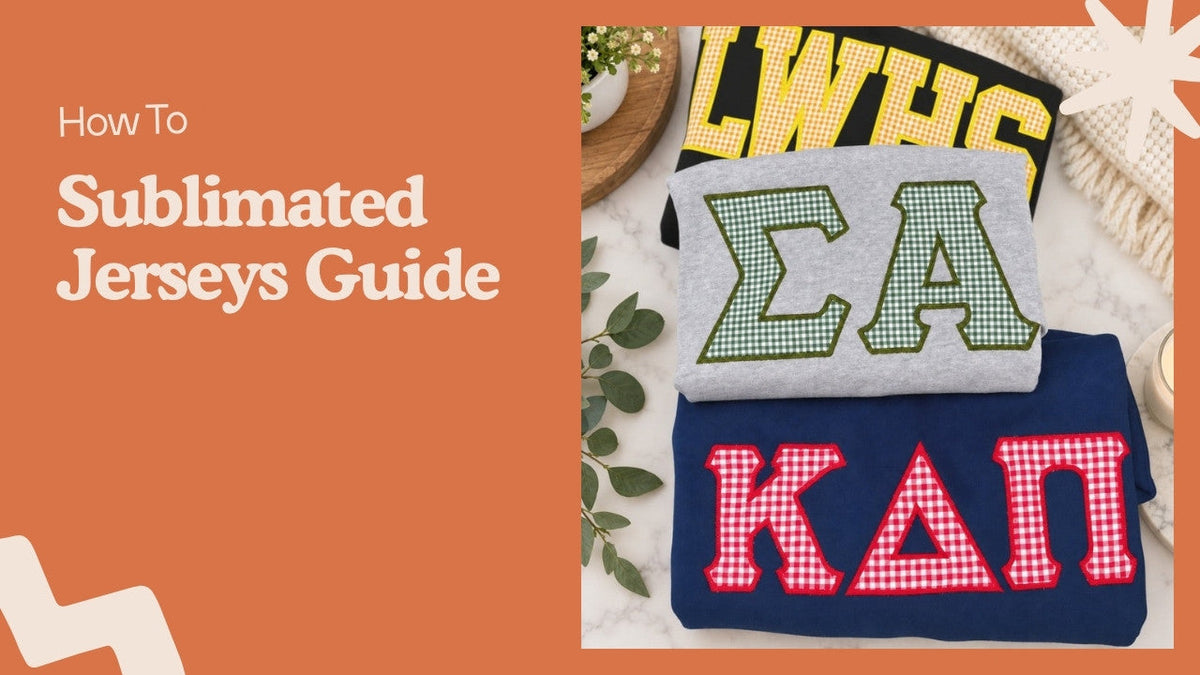
Some groups want matching letters off the field too. Stitched letters on a sweatshirt carry the same team feel as jersey lettering, with a heavier hand. Our custom gingham letters embroidered sweatshirt takes Greek letters or a short set of initials.
More name and initial pieces sit in our personalized embroidered gifts collection. Orders take 3-7 business days including production. Personalized items can't be returned, so check every spelling twice before ordering for a group.

Thread needs gentler laundry than a dye-sub jersey. Our guide on how to wash embroidered clothing without ruining it covers the cold-wash, low-heat routine.
Sublimated jersey FAQ
What does sublimated jersey mean?
It means the jersey's design was dyed into polyester fabric with heat, using ink that turns into a gas and bonds with the fibers. The colors are part of the fabric, not a layer on top.
Do sublimated jerseys crack or peel?
No, sublimated jerseys have no ink layer that could crack or peel. The colors can slowly dull after years of hot drying and strong sun, so cold washing helps.
Can you sublimate a cotton jersey?
Not well. Sublimation dye bonds with polyester, so on cotton the colors come out pale and fade quickly in the wash.
Does a sublimated jersey weigh more than a plain one?
No. The dye sits inside the fibers and adds no noticeable weight or stiffness, which is why sublimated uniforms suit hot-weather sports.
Can names and numbers be added to sublimated jerseys later?
Not by sublimation once the jersey is sewn and printed. A late addition usually gets a heat-transfer vinyl name or number pressed on top instead.
Can a sublimated jersey be dark with white lettering?
Yes, if the panels are printed before sewing. The dye colors white fabric dark and leaves the lettering areas white, but it can't print white onto fabric that's already dark.