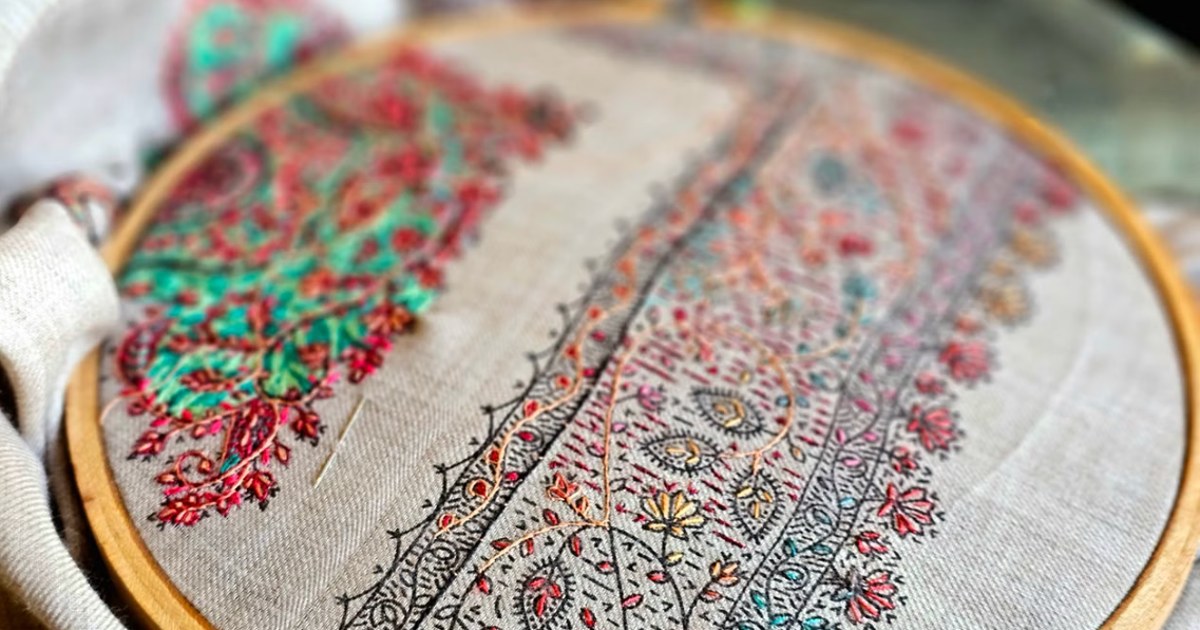
Types of embroidery fall into a few large families. The Victoria and Albert Museum in London sorts hand embroidery into counted-thread work, freestyle work and whitework. Machine embroidery on clothes adds a fourth group. This guide gives the names of embroidery styles in each family, how they look and which ones suit clothing.
Different types of embroidery at a glance
| Family | How it works | Examples |
|---|---|---|
| Counted-thread | Stitches follow a set number of fabric threads, usually on even-weave cloth | Cross-stitch, blackwork, bargello, kogin, canvas work, Berlin woolwork |
| Freestyle (surface) | The design is not limited by the weave of the fabric | Crewelwork, goldwork, stumpwork, Chinese silk embroidery, art needlework |
| Whitework | White thread on white fabric, often with holes as decoration | Broderie anglaise, cutwork, drawn thread work, pulled thread work, Ayrshire, Mountmellick |
| Machine embroidery | A computerized machine stitches a digital design | Flat embroidery, 3D puff, appliqué, chenille, monograms |
The counted-thread, freestyle and whitework groups and their examples come from the V&A guide Embroidery styles, an illustrated guide.
Counted-thread embroidery styles
1. Cross-stitch
Two diagonal stitches cross, with the second over the first. The V&A dates the earliest known example to AD 850. It is common on samplers and can show shading in pictures.
2. Blackwork
Monochrome embroidery seen on 16th- and 17th-century European caps, collars, cuffs and sleeves. Early pieces used small repeating fillings called "diaper" patterns.
3. Bargello
Bargello uses one vertical stitch, the Florentine, stepped up and down in wave-like bands. Britannica notes the stitch is also called flame or Hungarian stitch (Britannica, needlepoint).
4. Kogin
A Japanese darning-stitch style from Aomori Prefecture in the Edo period. White cotton stitches form diamond patterns on indigo cloth. Farmers used it to strengthen winter workwear.
5. Canvas work and needlepoint
Stitches cover a stiff, open-weave canvas, most often in tent stitch. Britannica says needlepoint was called canvas work until the early 19th century. Petit point uses about 16 to 20 or more holes per inch. Gros point uses about 7 or 8 to 16.
6. Berlin woolwork
Hard-wearing canvas work stitched in bold wools from printed patterns. It came from Berlin in the 1800s. The V&A reports more than 14,000 patterns had reached Britain by 1840.
Freestyle and surface embroidery styles
7. Crewelwork
Named after crewel, a fine two-ply wool yarn. Many stitches outline and fill colorful motifs. In late 17th-century England it decorated bed hangings and curtains.
8. Goldwork
Embroidery in gold or gilt-metal threads, practiced for at least 2,000 years. English goldwork from 1250 to 1350 is known as "opus anglicanum." It still appears on ceremonial and military regalia and couture eveningwear.
9. Stumpwork (raised work)
Padding and wired shapes create three-dimensional leaves, wings and petals. It was popular in the 17th century on decorated caskets.
10. Chinese silk embroidery (xiu)
Flat, untwisted silk gives a strong sheen. The V&A lists four regional styles: Shu xiu, Su xiu, Xiang xiu and Yue xiu.
11. Art needlework
A 19th-century style linked to William Morris and the Arts and Crafts movement. The Royal School of Needlework was founded in 1872 to support it.
Whitework embroidery styles
12. Broderie anglaise
Holes are cut and their edges overcast, often in floral shapes with scalloped edges. The V&A believes it began in eastern Europe in the 16th century.
13. Cutwork
Sections of woven fabric are cut away and the edges are stitched. The V&A traces it to Renaissance Italy.
14. Drawn thread work and Hardanger
Threads are pulled out of the fabric and the rest are stitched into patterns. Norwegian Hardanger uses it for geometric designs with small square holes.
15. Pulled thread work
Tight stitches pull loose-weave threads together to make a pattern of holes. Nothing is cut or removed.
16. Ayrshire work
Fine whitework on muslin, named after Ayr in Scotland. It was popular in the early 19th century for collars, cuffs, bonnets and robes.
17. Mountmellick
Whitework with no holes, developed around 1825 in Mountmellick, Ireland. Stitches sit on the surface and edges end in a heavy fringe.
Types of embroidery on clothes
Machine embroidery on clothes is stitched from a digital file. These are the machine types you will see most on shirts, hoodies and caps.
18. Flat embroidery
The standard style for names, initials and small logos on shirts, sweatshirts and caps. Stitches lie flat on the fabric.
19. 3D puff embroidery
Stitches cover a foam layer, so letters stand up from the fabric. It is common on cap fronts. Read our guide on what is 3D embroidery.
20. Appliqué
A fabric shape is stitched onto the garment, then edged with satin stitch. Varsity letters often use it.
21. Chenille
Looped yarn creates a soft, towel-like texture. It is common on letterman jackets and patches.
22. Monogram embroidery
One to three letters, often initials, stitched on a cuff, chest or towel. See how to embroider a towel for a home project.
Hand vs machine embroidery
| Feature | Hand embroidery | Machine embroidery |
|---|---|---|
| Tools | Needle, thread, hoop | Embroidery machine and a stitch file |
| Speed | Slower, stitch by stitch | Faster once the design is digitized |
| Repeatability | Each piece differs slightly | Same design every time |
| Best for | Art, heirlooms, learning | Clothing, caps, team orders, gifts |
A machine needs the design turned into a stitch file first. Our guide on embroidery digitizing explains how.
How to choose an embroidery style
- For a first hand project, try cross-stitch or simple crewelwork with a printed pattern.
- For clothing you will wash often, choose machine flat embroidery.
- For caps with bold logos, choose 3D puff.
- For linens and summer tops, look at broderie anglaise or other whitework.
- For a challenge, try goldwork or stumpwork.
For ready-made pieces with names and dates, browse our personalized embroidered gifts. To check whether a garment is embroidered, read what does embroidered mean.
Frequently asked questions
What are the main types of embroidery?
The V&A groups hand embroidery into counted-thread, freestyle and whitework. Machine embroidery is a separate group.
Which embroidery styles are good for beginners?
Cross-stitch and crewelwork are common starting points because patterns are easy to follow.
What type of embroidery is used on clothes?
Mostly machine flat embroidery, plus 3D puff on caps, appliqué on varsity wear and chenille on patches.
What is the difference between needlepoint and embroidery?
Needlepoint is a type of embroidery worked over a stiff canvas, usually in tent stitch.
What is whitework embroidery?
White thread on white fabric, often with cut or pulled holes as part of the design.
What is the oldest type of embroidery listed here?
Goldwork, which the V&A says has existed for at least 2,000 years.