Before you order a single hat with your logo on it, answer one question: who is going to wear this on a Saturday, unpaid? If the honest answer is "nobody," the order will sit in a box under the register. Maybe the answer is your staff, a few regulars, and the sister who brags about your shop. Then you already have the start of a plan.
Wearable marketing for small business means putting your name or logo on things people wear and carry every day. Your brand then travels to places your ads never reach. It works when the item is good enough that people choose it, and when the wearer is someone your future customers trust.
This guide covers which pieces to order first and how to get a logo that holds up in thread. It also shows how to tell whether any of it brings people through the door.
What wearable marketing for small business actually means
Start here if you keep hearing the term and want a plain definition before spending money. Branded tees, caps, aprons and totes all count. So does a sweatshirt you sell as merch, as long as your name is on it.
The difference from a flyer is ownership. You hand out a flyer and hope. Someone adopts a cap. Once they own it, they decide when it goes out in public, so quality and design carry real weight.
Small shops tend to use it in three ways:
- Uniforms that make staff easy to spot, like a cafe apron or a crew shirt for a landscaping team.
- Giveaways for loyal customers, event volunteers or the first fifty people at a grand opening.
- Merch that customers buy because they like you, which turns marketing into a small revenue line.
Most businesses end up doing a mix. Picture a bakery that dresses its counter staff in matching aprons. Once regulars start asking where to get one, it adds a sweatshirt with a croissant on the chest.
Who wears it decides whether it works
Read this before you pick products. The wearer matters more than the garment, because your logo only reaches the people who see that person.
Your staff
Employees are the easiest audience to equip and the most visible. They stand at the counter, ride in the work truck and walk to lunch in whatever you hand them. Give them something comfortable in sizes that fit, and they will wear it off the clock too. Hand them a stiff, boxy shirt instead and it becomes a painting rag.
Let staff weigh in before you order. Show two or three color options and let the team vote. People wear what they helped choose, and the vote takes five minutes at a staff meeting.
Regulars and fans
Picture a regular wearing your cap to a ballgame. Strangers ask where it's from, and the answer comes with a recommendation attached. No billboard can do that. Save your best-looking piece for this group.
Event crowds
Farmers markets, 5K runs and school fundraisers put the same logo in front of hundreds of strangers. Totes shine here. People carry them for the rest of the day, then reuse them at the grocery store.
Friends and family
Your earliest supporters are often relatives and old friends. They already talk about your business at work and at family dinners. Give them something to wear while they do it, and every mention gets a visual.
You
Owners forget themselves. If you run a one-person business, your own hat is the cheapest ad you will ever buy. Wear it to the hardware store. Wear it in the photo you post when a big order ships.
Which branded apparel to order first
This is for owners on a small budget who need to choose one or two items, not ten. Start with what your business already needs, then add pieces people will pick for fun.
Food and drink
An apron does double duty. It protects clothes and puts your name at eye level across the counter. Our Custom Logo Embroidered Apron is one example. It carries a stitched shop logo and comes in several colors, so a team can match or mix.

Trades and outdoor crews
Caps keep sun off the face and put your name on the part of a person seen from farthest away. Ours are cotton twill with an adjustable closure. They fit head sizes from about 21 to 24 inches, so you skip collecting hat sizes from the whole team. Browse our embroidered hats and caps to see the styles we stitch.
Boutiques, salons and studios
Heavyweight sweatshirts read as merch rather than uniform. Customers buy one, wear it to brunch, and it turns up in their photos. Ours use thick cotton and fleece with a relaxed fit. See the range in our embroidered hoodies and sweatshirts.
Market booths and pop-ups
Canvas totes hold purchases, so they get used right away. Later they show up at the gym, the library and the beach.
If you can only afford one item, pick the one your staff will wear every working day. Daily use beats a nicer piece that comes out twice a year.
Wearable marketing ideas by type of business
Need a starting idea for your own trade? These pairings come from how each business meets its customers.
- Coffee shops: aprons for the bar, then a sweatshirt with a pun on your best-selling drink for regulars.
- Landscapers and roofers get the most from caps, since customers see crews from the street, not up close.
- Hair salons can sell totes at the front desk, because clients already carry products home.
- Dog groomers might stitch the shop name small and a paw print large. Owners love wearing anything pet-related.
- Bookstores could try a sweatshirt with a line about reading, with the store name on the sleeve.
- Food trucks rotate locations, so the crew's matching caps help repeat customers spot you across a crowded lot.
- For Etsy and online sellers, a branded tote in each local pickup order turns packaging into something useful.
How to split a small budget
Got a fixed amount to spend and want it to stretch? Think in layers rather than one big order.
First layer: one piece for every person who faces customers. That might be four aprons or six caps. It is the order that pays for itself through daily visibility, so it comes first.
Second layer: a small batch for your most loyal customers. Ten pieces handed to the right people often travel further than fifty handed to strangers. Choose the regulars who already bring friends in.
Third layer, once the first two prove themselves: merch for sale. Selling sweatshirts or totes at the counter can cover the cost of the next staff order.
Leave a little room for reorders. New hires need gear too, and nothing looks sloppier than one employee in a different shirt for three months.
When to hand out branded gear
Timing matters for giveaways and staff kits alike. Gear handed out at the right moment gets worn sooner and talked about more.
Openings and anniversaries are the obvious choice. People who show up on day one or for your fifth birthday are already fans, so they make good wearers.
New hires are a quieter opportunity. Put a cap and a shirt on the first-day welcome pile. It tells the new person they belong, and it puts one more uniformed face on the floor right away.
Holidays work well for customer thank-you gifts. Handing a regular a sweatshirt in early December feels generous, and they'll wear it all winter. Just remember the calendar: holiday weeks slow down production and shipping everywhere, so order early.
Reviews and referrals are another trigger. When a customer sends three friends your way, a tote or cap is a thank-you they will actually use. Skip the coupon they'll forget.
Matching the item to the season
Sweatshirts get the most wear from October through March. Caps peak in spring and summer, when people are outdoors and squinting. Totes and aprons work year-round.
If you're placing your first order in autumn, lead with sweatshirts. Plan the cap order for late winter so it arrives before the first warm weekend.
Embroidered logo or printed logo
This part helps you choose a decoration method, especially for hats and anything washed often. We only embroider, so take our view with that in mind.
Printed ink sits on top of the fabric, while embroidery is thread stitched into it. In our experience, prints start to crack and peel after 20 to 30 washes. Stitching stays put as long as the garment lasts.
For a uniform that goes through the laundry every week, that difference shows up within a season. We go deeper on this in embroidery vs screen printing and which lasts longer.
Print still has its place. Logos with photo detail, soft gradients or a dozen colors are hard to reproduce in thread. Cheap event tees that only need to last one weekend may also be fine printed.
Hats are where embroidery has the clearest edge. The front of a cap is curved with a seam down the middle, and ink struggles there. Thread handles it, but the design must be planned for the curve. Our article on why embroidery on hats is different explains how.
Designing a logo that survives stitching
This section is for anyone turning an existing logo into thread. Most logos were made for a screen or a business card. Some translate perfectly, others need simplifying.
Thin lines are the first problem. A hairline stroke that looks crisp on a website can vanish or wobble in thread. Tiny text has the same issue. That tagline under your name may turn into a blur on a cap front.
Color count comes next. Every thread color is a separate pass on the machine, so a nine-shade logo gets heavy and stiff. Two or three colors usually look cleaner.
Then there's contrast. Pick a thread color that stands apart from the fabric. Navy thread on a black hoodie looks great up close and invisible from across a parking lot.
In our own shop, every new design gets test-stitched on scrap fabric first. That lets us adjust stitch density before it touches a real garment.
Detailed designs run four to nine minutes on the machine. Curious why some logos feel thicker than others? Read what stitch count means.
Name first, icon second
Unless people already know your symbol, lead with your business name. Clever abstract marks tell a stranger nothing. "Sarah's Bakery and Coffee" in clean script tells them what you sell and what to search for.
Placement
Left chest is the standard for staff shirts and looks professional at a counter. The center of a cap front is the most visible spot on any garment. Larger back designs suit event crews, who are seen walking away more often than facing you.
Making shirts and hats people actually want to wear
Read on if you want customers wearing your brand, beyond the staff. Plain logos on plain tees are uniforms, and people wear uniforms because they have to.
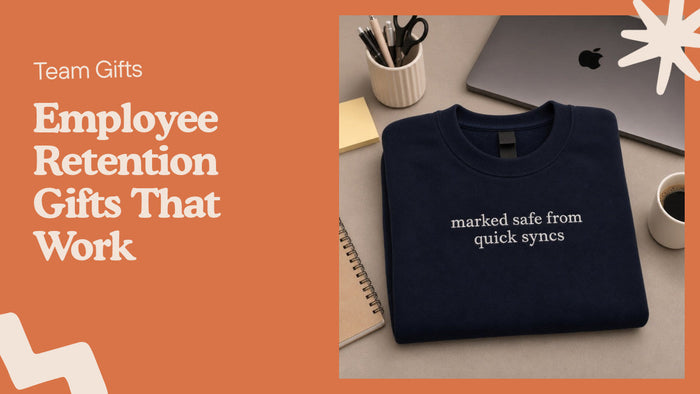
Merch that gets picked from the drawer on a day off usually has something extra. Sometimes it's a joke that fits the brand. Think of a coffee shop printing "Decaf is a conspiracy" across the chest, with the logo small on the sleeve.
Sometimes it's the feel: soft, heavy fabric and a fit that suits real bodies. And sometimes it simply looks like it came from a clothing brand rather than a trade show booth.
Personal touches help too. Stitch a name on a tote or apron and it feels like a gift rather than a handout. People hang on to gifts.

Our embroidered tote bags use heavy canvas. The script style above works just as well for a shop name as a family name.
One warning about humor. Sarcastic and dark jokes sell well as personal gifts, but on business apparel they speak for your company. Keep the joke gentle unless edgy humor is already part of your brand.
How to order branded apparel in 6 steps
Use this checklist when you're ready to place a first order, whether with us or anyone else.
- Decide who will wear it and where. Counter staff, outdoor crews and fans at a game need different pieces.
- Pick one or two products and confirm sizing. Our tops are unisex and true to size with a relaxed fit. Between sizes, go up one.
- Get a clean logo file. Vector files are best, though a sharp, high-resolution image can work. Simplify thin lines and tiny text first.
- Choose fabric and thread colors with strong contrast. Then check the spelling of every name and word twice.
- Look at a preview at actual size, not zoomed in on a laptop screen.
- Order with time to spare. Our production takes 1-3 business days and shipping 2-4 more, so 3-7 business days in total. For an event, order at least 10 days ahead.
For a longer walkthrough, read how to order custom embroidered merch step by step.
Common mistakes with wearable marketing
This list is for owners who want to avoid wasting a first order. Each one is easy to catch before you pay.
- Buying the cheapest blank. Thin, scratchy shirts say something about your service, and staff stop wearing them within a month.
- Shrinking a detailed logo onto a cap. The tagline and fine lines disappear, so strip it back to the name and one symbol.
- Thread that blends into the fabric. Tone-on-tone looks stylish in a photo and unreadable on the street.
- Sizing up because "oversized is in." Relaxed cuts are already roomy, and one size up is plenty.
- Spelling mistakes on personalized pieces. Items made with names can't be returned at our shop, which is common elsewhere too.
- Ordering two days before the event. Made-to-order items need production time, so plan backward from the date.
- Forgetting people outside your payroll. Loyal customers would happily wear your logo, yet few owners ever offer.
- Choosing a joke only the owner finds funny. Run the design past two or three staff members before ordering.
How to tell if your wearable marketing is working
Want some proof before ordering a second batch? You won't get perfect numbers, but you can get useful signals.
Ask how customers heard about you. Add the question to your checkout or intake form, with "saw your shirt or hat" as an option. It costs nothing, and after a few months you'll have real answers instead of guesses.
Put a short code on a card inside the tote or on the hang tag. Make it a simple discount word. When that word shows up at the register, you know the item did its job.
Watch social media. Customers who tag your business in photos while wearing your gear give you reach you never paid for. Count those posts each month.
Track wear among staff as well. If half the team has stopped wearing the cap, ask why. Usually it's fit, fabric or a design they find embarrassing. All of these are fixable on the next order.
Keeping embroidered logos looking new
Share these care steps with your team, or tuck a card into any piece you give away. Faded, wrinkled logos work against you.
- Turn garments inside out and wash in cold water on a gentle cycle.
- Tumble dry on low heat or hang to dry.
- Never iron directly on the embroidery, and skip bleach and fabric softener.
- Fold sweatshirts instead of hanging them, so the shoulders don't stretch.
- Stuff caps with paper when storing them so the front panel keeps its shape.
We use French DMC thread, which holds its color and doesn't bleed. Even so, good thread looks tired on a garment that has been boiled and ironed flat. The full routine is in how to wash embroidered clothing without ruining it.
FAQ about wearable marketing for small business
Is wearable marketing worth it for a very small business?
Yes, if the pieces get worn. Good caps or aprons that staff use daily keep a small business's name in public for months, at a one-time cost.
What is the best first item for branded apparel?
Pick what your team already needs for work, such as aprons for a cafe or caps for an outdoor crew. Daily use gives the most exposure.
Should a business logo be embroidered or printed?
Embroidery lasts longer and suits hats, uniforms and anything washed often. Printing suits photo-like designs and one-time event shirts.
How long does it take to get embroidered apparel from Me Do Embroidery?
Every item is made to order. Production takes 1-3 business days and US shipping 2-4 more, so 3-7 business days in total.
How do I make sure my logo looks good in embroidery?
Keep it to two or three colors, remove very thin lines and small text, and choose thread that contrasts with the fabric.
How do I wash embroidered work shirts and hats?
Wash inside out in cold water on a gentle cycle, dry on low heat, and never iron directly over the stitching.
Have a logo you'd like to see in thread, or want to ask about a design on a different item? Email us at support@medoembroidery.com and we'll reply within one business day.