By the middle of December, a pile of gifts covers half of your tree skirt. That changes how you plan a classic Christmas tree skirt. The embroidery has to sit where people see it, and panels hidden under gifts can stay plain.
An embroidered tree skirt is a round skirt sewn from 12 wedge-shaped panels. Each panel is embroidered on a larger piece of fabric first, then cut out. Stabilize the fabric, hoop it flat, stitch the design, cut the panel, then join all 12 panels to a lining. Plan a full weekend, and start in October if you want it under the tree on time.
What You Need for an Embroidered Tree Skirt
This list is for anyone with a home embroidery machine and a basic sewing machine. Nothing here is exotic, but the stabilizer choice matters more than most people expect.
- Top fabric and matching lining fabric. Buy after you lay the paper pattern across the fabric width, because yardage depends on how wide the bolt is.
- Medium weight cutaway stabilizer for the stitching, plus temporary spray adhesive.
- Water-soluble topper if the top fabric has a pile, such as velvet or faux fur.
- Embroidery thread, plus ordinary sewing thread in colors that match both fabrics.
- Kraft paper or taped printer sheets for the pattern, a ruler, a fabric marker and pins or clips.
- Ribbon, cord or fabric strips for six ties, and trim if you want a border.
How Big Should a Christmas Tree Skirt Be?
Pick the size before you pick the design, because the diameter decides how wide each panel is and how large a design will fit.
Measure the spread of your tree's lowest branches and add a few inches on each side. A 48 inch skirt is a common starting point for a full-size tree.
For that size the math is simple. Twelve panels split 360 degrees into 30 degree wedges. Draw two lines 24 inches long from one point, 30 degrees apart. Join their ends with a straight line of about 12.4 inches.
Measure 3 inches down from the point and cut across, which leaves a 6 inch center hole. Add a 1/2 inch seam allowance on every side before you cut fabric.
Want a different diameter? Use half of it as the line length. Multiply the full diameter by 0.26 to get the width at the bottom of each panel. A 60 inch skirt needs panels about 15.5 inches across.
Skirt Embroidery Design Ideas for Classic, Nativity and Applique Styles
This section is for the moment you stand in front of a design library and have 3,000 files to scroll through. A tree skirt panel is a long triangle, so the best designs are tall and narrow or sit low where the wedge is wide.
Classic Christmas motifs
Ornaments, holly, pine boughs and scrollwork corner designs suit a classic look. Repeat one motif on all 12 panels for a formal skirt, or alternate two motifs for something that feels less strict. A single corner design turned toward the outer edge fills the wide end of the wedge without crowding the narrow end near the tree.
Nativity Christmas tree skirt pattern
A nativity scene is a lot of fine detail, so give it room. One scene on each of the two or three front-facing panels works better than twelve small ones.
Test it on scrap first: small faces and animals show thread tension problems quickly. If the design is wider than the bottom of the wedge, choose a smaller version. Do not let it run into the seam allowance.
Applique Christmas tree skirt pattern
An applique Christmas tree skirt pattern gives you bold shapes with fewer stitches, which is gentler on heavy fabrics like velvet. Felt or cotton shapes held down with a satin outline read clearly from across the room. Applique also helps if your machine struggles with stitch-dense fills across 12 panels.
Whatever style you pick, print a paper template of the design and lay it on the pattern piece. Leave at least the full seam allowance between the design and the edge.
How to Make an Embroidery Christmas Tree Skirt Step by Step
These steps are for the 12-panel version with a lining and a back opening. Each panel gets embroidered while it is still a rectangle, which is far easier to hoop than a wedge.
- Draw the wedge pattern at your chosen diameter, add seam allowance, and cut it out of paper.
- Choose where the design goes. Set the paper template on the wedge and mark the center and the vertical axis.
- Cut a rectangle of top fabric a few inches larger than the wedge, so there is room to hoop. Spray a piece of cutaway stabilizer with adhesive and smooth it onto the back.
- Trace the wedge on the right side of the fabric, then draw crosshair lines through the planned center of the design.
- Hoop the fabric and stabilizer together, matching your crosshairs to the hoop marks. The fabric should be flat and taut, not stretched.
- If the fabric has a pile, tape a water-soluble topper over the design area. Tape it to the hoop, not the fabric.
- Line the needle up over the center mark, then stitch the design. Remove the topper, turn the fabric over and trim the stabilizer about 1/4 inch from the design.
- Cut out the wedge along your traced lines. Repeat until you have 12 top panels, embroidered or plain in whatever mix you like.
- Lay out the panels in a circle and choose two to be the back. Sew the other panels together side by side with a 1/2 inch seam and press the seams open. Leave the seam between the two back panels open.
- Cut 12 lining wedges and join them the same way, again leaving the back seam open.
- Pin three ties along each side of the back opening: one near the top, one in the middle and one near the bottom. Sew trim to the outer edge now if you are using it.
- Place the lining over the top with right sides together. Sew around the whole outline and leave a 4 inch gap between two ties for turning. Clip the corners, turn it right side out, press, and topstitch the gap closed.
If you want the skirt to lie flatter, quilt along the panel seams with thread that matches the top and bottom fabrics.
Fabric and Stabilizer Choices That Change the Result
Read this before you buy fabric if you have never stitched on anything thicker than a T-shirt. The fabric you choose changes the stabilizer, the topper and how the finished skirt hangs.
- Velvet and velour give the richest look, but the pile swallows stitches. Use a water-soluble topper and hoop gently, because hoop pressure leaves marks in some velvets.
- Cotton and linen blends are the easiest to stitch and hold detail well, so they suit nativity scenes and small lettering. They look flatter under the tree, so add trim.
- Suede or faux suede is fussy: needle holes stay visible, so stitch each design once and do not rip out.
- Satin makes a good lining because it slides over the tree and gifts without catching.
Cutaway stabilizer is the safe choice for dense designs, since the skirt will be handled, packed and dragged around the tree base each year. Tearaway stabilizer can loosen stitching over time. We back every piece we embroider with stabilizer for the same reason: it keeps the stitching flat and the fabric from puckering.

Mistakes to Avoid When You Embroider a Tree Skirt
These are for the second hour of the project, when the first panel is hooped and it is tempting to hurry.
- Skipping the scrap test. Stitch the design on a leftover piece of the same fabric and stabilizer. We do this with every new design before it goes on a garment, and it catches thread breaks and puckering early.
- Placing the design too close to the tip. The narrow end of a wedge is only a couple of inches wide, so keep the design in the lower two thirds.
- Cutting all 12 panels before embroidering. Embroidery pulls the fabric slightly, so cut the wedge after stitching, not before.
- Forgetting the direction of the design. Mark "top" on the template so you do not sew a panel upside down.
- Ironing straight onto stitching. Press from the back on a towel, and use a pressing cloth on the front.
- Starting in December. Twelve panels take longer than people plan for. Embroider a few each evening instead of one marathon.
Not Ready to Sew a Whole Skirt? Try Embroidered Christmas Gifts Instead
This section is for anyone who loves the idea of an embroidered tree skirt but has no spare weekend, or no machine. We do not list a tree skirt right now. The same classic Christmas look comes in smaller pieces.
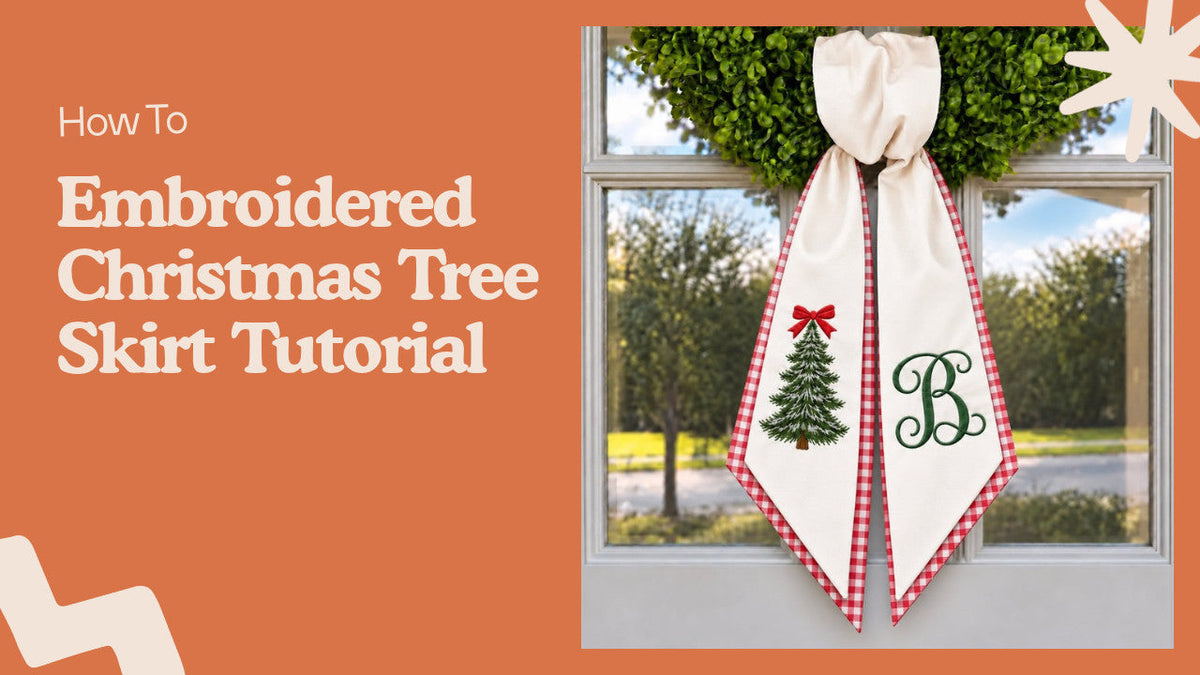
Our Christmas stocking collection includes the custom name embroidered Christmas stocking, which hangs from the mantel beside the tree. A wreath sash carries an embroidered tree onto the front door, and the personalized Christmas tree baby hoop works as a first-Christmas keepsake. You can browse the rest in our Christmas embroidered gifts and personalized embroidered gifts collections.
Everything is made to order. Production takes 1 to 3 business days and shipping takes 2 to 4. Allow 3 to 7 business days in total, and order at least 10 days before you need it. Personalized items cannot be returned, so check the spelling of a name before you order.
Embroidered Tree Skirt FAQ
How many panels should I embroider?
As many as you like. The skirt needs 12 top panels, but you can embroider all of them, only the front four, or alternate embroidered and plain panels.
What stabilizer works best for an embroidered tree skirt?
Medium weight cutaway stabilizer. It supports dense stitching for years of storage and handling. Add a water-soluble topper on velvet, velour or faux fur.
Can I embroider a tree skirt on velvet?
Yes. Use a topper so the stitches sit on top of the pile. Hoop with light pressure and test on a scrap of the same velvet first.
What size should a Christmas tree skirt be?
Measure the spread of the lowest branches and add a few inches on each side. A 48 inch diameter is a common size for a full-size tree.
How do I clean an embroidered tree skirt?
Spot clean when you can. Velvet and trim often rule out machine washing, so follow the fabric's care label. Wash cotton before cutting if you plan to launder the finished skirt.
Do you sell embroidered Christmas tree skirts?
Not at the moment. We make embroidered Christmas stockings, wreath sashes, hoops and sweatshirts, all stitched to order in the USA.