Glow thread stitches like any other specialty thread until you rush it. Run it at full speed with a tired needle and it frays before the first color change. Embroidering with glow thread goes smoothly once you change a few habits.
Embroidering with glow thread works best with a fresh metallic or topstitch needle and a slower machine speed. Add a test stitch-out on scrap fabric before the real piece. Pick a design with open, light stitching, keep the glow thread on top only, then charge the finished embroidery under a bright lamp. That routine prevents most breaks and gives the strongest glow.
What glow in the dark thread embroidery looks like
This section is for anyone deciding whether glow thread suits a project, from Halloween shirts to a kid's pajama pocket.
Glow thread holds light in a special pigment and gives it back slowly once the room goes dark. In daylight it reads as a pale thread, often white or soft yellow. In the dark it shows a faint green or yellow-green outline.
The glow is dim, closer to a night-light than a lamp. Small details and thin lines vanish quickly. Bold shapes, stars, eyes and outlines hold up much better.
Glow thread is not reflective gear either. It will not light up under headlights, so do not count on it for night safety.
How to embroider with glow thread, step by step
Use this order the first time you load a spool, and keep it for every project after that.
- Choose a design with light stitching. Dense fills pile up friction and heat, and thin glow thread gives up first. Our guide to what stitch count means explains why fewer stitches also means a softer finish.
- Put in a new needle. A metallic or topstitch needle in size 90/14 is a common starting point because the larger eye lets the thread pass with less rubbing.
- Thread glow thread on top only. Your usual bobbin thread in a matching color works fine underneath.
- Slow the machine down. Many people start around 400 to 600 stitches per minute and raise the speed only if the thread runs clean.
- Hoop the fabric with the right stabilizer behind it so the stitches lie flat and the fabric does not pucker.
- Stitch the design once on a scrap of the same fabric. Look at fuzz, thread breaks and how the glow reads before you commit.
- Stitch the real piece, trim the jump stitches gently with small scissors, and charge it under a light.
Best glow in the dark embroidery thread and how to choose it
Read this before buying your first spool, or when a spool you already own keeps breaking.
Glow thread comes from a short list of makers. Coats and Clark Glow-in-the-Dark and Fil-Tec Luminary are two brands sold for machine embroidery. Most glow designs are digitized for 40 weight, so look for that number on the spool label.
Why the same weight can behave differently
Two spools labeled 40 weight can stitch very differently, because each maker builds the glow pigment into the thread in its own way. One may run quietly at medium speed while another shreds at the same setting.
Buy a single spool first. Stitch a small test with it before you order a dozen colors.
Compare daylight color and glow color
A spool that looks white by day can glow green, and a yellow-looking spool can glow a different shade. Pick a color that blends into the fabric for a hidden glow, or a contrast color for a design that shows in both lights.
How to charge thread glow and keep it bright
Charging matters because a glow spool that has sat in a drawer for a week will look dead until it sees light.
Charging a finished design
Hold the embroidery under a bright lamp or in direct sunlight for several minutes, then turn the room dark. Brighter light and a shorter distance charge it faster. Every glow fades after a while, and a fresh charge brings it back as often as you like.
Making light up thread glow brighter
If the glow looks weak, check these causes in order:
- The stitching is too thin, so little glow thread sits on the surface.
- Another thread color covers the glow thread in layered areas.
- The embroidery needs a longer charge under a stronger light.
- The spool is old or has been stored in bright heat.
Fixing thread breaks and fuzz
Glow thread is thinner than standard rayon or polyester, and it breaks more easily. This section is for the moment the machine stops for the third time.
Slow the machine down
Speed creates friction between the needle, the fabric and the stabilizer. Lower the speed one step at a time until the thread runs without stopping.
Change the needle
Needles pick up tiny rough spots that saw through thread, and you cannot always see them. Swap in a new one before blaming the spool. Glow pigment is also abrasive, which wears needles faster than you might expect.
Check the thread path and tension
Rethread from the spool and watch for snags on the cap or the guides. A thread stand helps if the spool jerks as it unwinds. If the thread still shreds, loosen the top tension a little and run another test.
Designs and fabrics that suit glow thread
Use this when you are picking a first project and want a good chance of success.
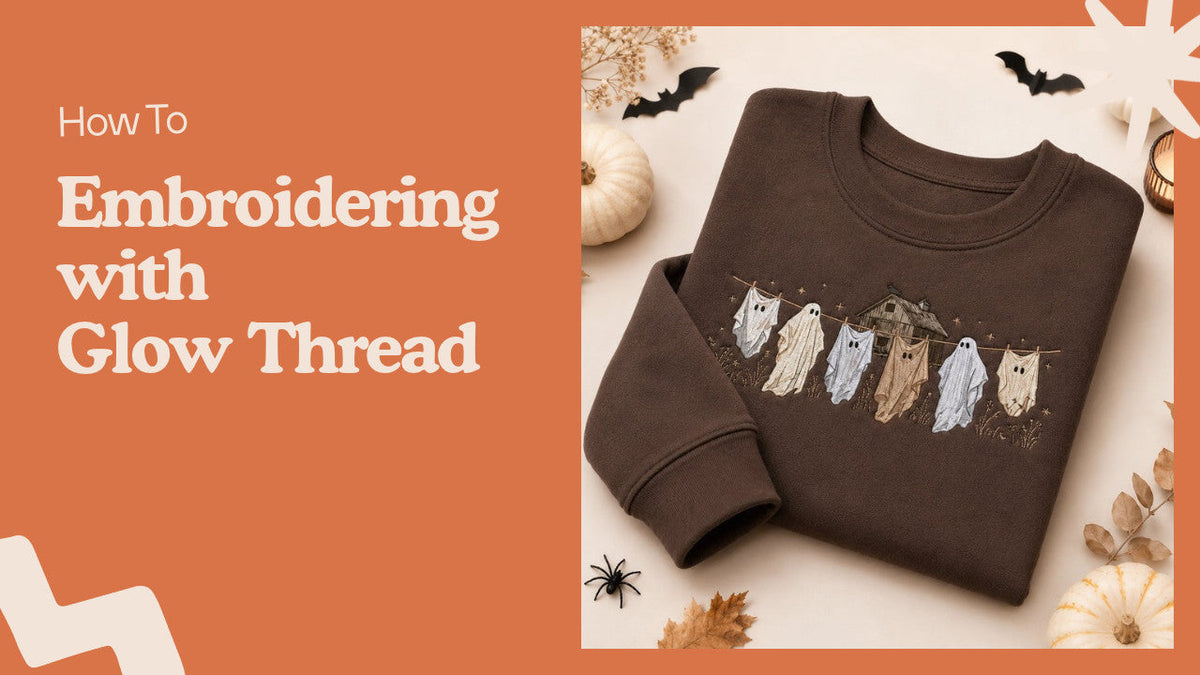
Light, airy designs are the easiest. Redwork, vintage line art, stars, moons and ghosts all let the glow show without heavy fills. Pale glow thread on dark fabric shows up in daylight too. On light fabric it nearly disappears until the lights go off.
Halloween is the obvious home for this. Our own pieces in the Halloween embroidered gifts collection use French DMC thread, not glow thread. Their ghosts and bats show the outline-style artwork that would translate well to a glowing version.

If you want to understand how a design file becomes stitches, read what digitizing means in embroidery.
How to wash glow thread embroidery
This applies to anything you plan to wear more than once.
Follow the care instructions from the thread maker first, since some glow threads warn against excess heat from the dryer or iron. Turn the garment inside out and wash it in cold water on a gentle cycle. Dry it on low heat or hang it up. Do not iron directly on the embroidery, and skip bleach and fabric softener.
The same rules protect any stitched garment, and our guide to washing embroidered clothing covers them in more detail.
Mistakes to avoid with glow thread
Most failed glow projects share one of these slips.
- Skipping the test stitch-out and finding a problem on the finished garment.
- Using the needle that was already in the machine from the last job.
- Choosing a dense fill that smothers the thread and the glow.
- Expecting a lamp-level glow from a handful of tiny stitches.
- Ironing the embroidery flat after washing.
- Buying many colors of one brand before testing a single spool.
Glow in the dark thread embroidery FAQ
Can I use glow thread in a regular embroidery machine?
Yes. Use a fresh metallic or topstitch needle, slow the speed, and test on scrap fabric first. Glow thread does not need a special machine.
What needle works best for glow thread?
A metallic or topstitch needle, often size 90/14, works well because its larger eye reduces friction. Replace it often.
How long does glow thread glow?
It depends on the brand, the stitch coverage and how long you charged it. The glow is brightest right after charging and fades gradually, so expect to recharge it.
Does glow thread wash well?
Usually, when you wash it cold and dry it on low heat. Check the maker's instructions, because some brands ask you to avoid heat to keep the glow.
Is glow thread good for safety gear?
No. It glows faintly and only for a while after charging, and it is not reflective. Use proper reflective material for night safety.
Prefer to wear embroidery rather than stitch it? Browse our personalized embroidered gifts or the best sellers. Every piece is stitched to order and ships in 3 to 7 business days.