A tea towel looks like the easy canvas: flat, cotton, cheap. Then the first wash arrives. The fabric shrinks around a dense design, and the corners pucker like a collar one size too tight. Most bad results with embroidering on tea towels come from skipped prep, not from the design itself.
To embroider a tea towel, wash and press it first. Hoop it with a medium-weight cutaway stabilizer, stitch a light or medium design with a 75/11 needle, then trim the stabilizer back. That routine suits most cotton and cotton-linen towels. Sheer or very thin towels need a gentler setup, covered in the problems section below.
We stitch sweatshirts, hats and totes by machine to order, with stabilizer behind every design. Each new design runs on scrap fabric before it goes near a garment. Towels follow the same logic, so the steps here borrow from that workflow.
What You Need for Embroidered Tea Towels
This list is for anyone setting up a first batch on a home machine. Buy one more towel than you plan to finish, because the extra one becomes your test piece.
- Cotton tea towels, one per design plus a spare for test stitching
- Cutaway stabilizer, medium weight (around 2.5 ounce)
- An air-erasable or water-soluble marking pen
- A paper printout of the design, sized to your hoop
- Needles in size 75/11, either sharp or embroidery type
- Polyester embroidery thread, which handles frequent laundering well
- Small sharp scissors for trimming the back
Never run an embroidery machine before? Our beginner's guide to using an embroidery machine covers threading, hooping and the first test run.
Choosing Tea Towels for Embroidery
Pick the towel before you pick the design. The weave decides how well stitches sit on top of the cloth. It also decides how much the towel moves inside the hoop.
Fabrics That Stitch Well
- Flour sack cloth is smooth and tightly woven, so fine details stay crisp.
- Cotton-linen blends look good in a farmhouse kitchen and hold their shape in the hoop.
- Plain-weave cotton with a flat hem gives you a clean, even area for placement.
Fabrics That Need Extra Care
- Waffle weave has deep pockets that swallow thread, so use a water-soluble topping and a bolder design.
- Terry cloth has loops that poke through satin stitches. The same topping helps, and small lettering is a bad idea.
- Thin, see-through towels show the stabilizer from behind. Keep the design very light.
Whatever you choose, check the label. Towels that are not pre-shrunk will lose a little size in the dryer, which is why the first step below is always a wash.
How to Embroider a Tea Towel in 8 Steps
Use this sequence the first time and any time a result disappoints you. Each step prevents one specific problem.
- Wash, dry and press the towel. Skip fabric softener, since it leaves a film that can make the fabric slip.
- Print the design as a paper template. Lay it on the towel and fold the towel in half to see how it will hang. Then mark the center point and both axis lines.
- Cut a piece of cutaway stabilizer larger than your hoop. It stays in the towel for good, so it supports the stitches through every future wash.
- Hoop the towel and stabilizer together. Match the marks on the towel to the marks on the hoop and keep the weave straight without pulling it.
- Load a fresh 75/11 needle and thread the machine. Bring the needle down over the center mark and, if your machine offers it, trace the design outline once.
- Start stitching and stay close for the first minute. Early gaps or thread nests are easy to catch then and expensive to catch later.
- Take the hoop off and cut the stabilizer back, leaving roughly a half inch around the stitching.
- Press the towel from the back over a soft pad, with a pressing cloth between the iron and the thread.
Prefer needle and floss? Our guide on how to embroider a towel by hand or machine covers the hand-stitching route.
Embroidery on Kitchen Towels and Which Designs Suit Them
This section helps when you already own the towels and need to choose what goes on them. A kitchen towel is washed often and folded over an oven handle, so the design has to survive both.
Machine Embroidery Designs for Kitchen Towels
Aim for a low to medium stitch count. Outline drawings, single-color motifs, small fruit and herb sprigs, and short lettering all behave well. Heavy fills pull the weave inward, and towels have no body to resist that pull. What stitch count means explains how density affects both the look and the price of a design.
Dish Towel Embroidery Patterns That Stitch Cleanly
Open shapes with even line widths are the safest pick. Think of a whisk, a lemon, a row of seven small icons for the days of the week, or a monogram in one corner. If you like initials, how to embroider a monogram shows how to size and center them.
Are Free Tea Towel Embroidery Patterns Worth It
Yes, as practice material. Free files vary a lot, so run each one on a spare towel first. Check the file format against your machine and the size against your hoop. Watch for stitches that stack up in one spot.
Fixing Common Problems With Embroidered Tea Towels
Use this list when a finished towel looks wrong. Most flaws trace back to one of five causes.
- Puckering around the design usually means the stabilizer was too light or the towel was never prewashed.
- A gap between an outline and its fill points to fabric that shifted in the hoop. Rehoop with firm, even tension.
- When the thread sinks into a textured weave, add a water-soluble topping over the cloth before stitching.
- Stabilizer showing through a thin towel can be avoided with tear-away stabilizer, but only for a very light design and a sharp needle. Embroidery needles leave larger holes that weaken tear-away material.
- Marking lines that refuse to disappear come from skipping a pen test. Try the pen on the spare towel first.
Washing and Caring for Embroidered Tea Towels
Care matters most for towels you plan to give away, since the recipient will wash them within a week.
Our care guide for embroidered garments applies here too. Turn the towel inside out, wash in cold water on a gentle cycle, and dry on low heat or hang it. Skip bleach and fabric softener.
When a crease needs pressing, iron from the back and never directly on the stitching. For more detail, read how to wash embroidered clothing without ruining it.
Embroidered Tea Towels as Gifts
If you are stitching towels for a housewarming or a holiday, make two and keep one. Add a card with the washing instructions above, because a well-made towel still fails under hot water.
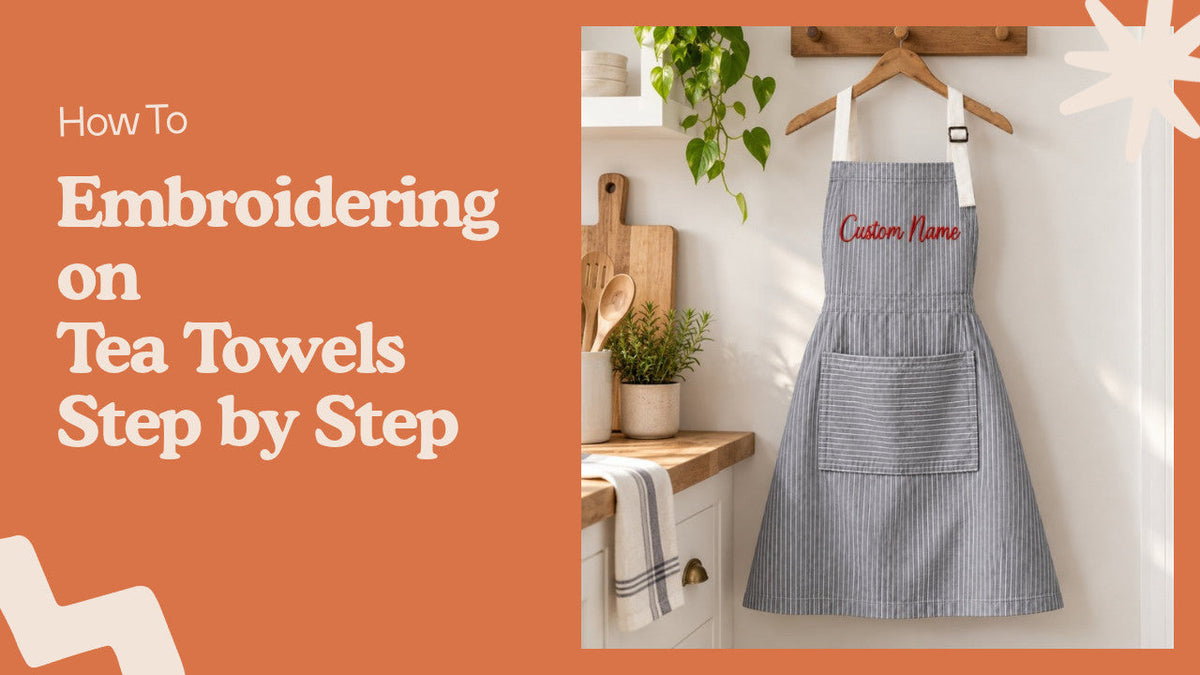
Not everyone has the time or a machine. Another kitchen gift that carries a name is an apron. The Custom Name Embroidered Apron is striped, with the name stitched in red thread on the chest. It pairs well with a hand-stitched towel as a set.

Personalized items cannot be returned, so check the spelling twice before you order. Orders ship from the USA and arrive in 3-7 business days in total. Allow at least 10 days if you are buying for a specific date. You can also browse more personalized embroidered gifts or the full apron collection.
FAQ About Embroidering on Tea Towels
What stabilizer is best for embroidering on tea towels?
A medium-weight cutaway stabilizer works for most cotton towels. It stays under the stitching and keeps the design from distorting in the wash.
Can I embroider dish towels the same way?
Yes. Dish towels and tea towels share the same cotton construction, so the steps, stabilizer and needle all stay the same. Only the towel size and placement change.
Do I need to prewash a tea towel before embroidering?
Yes. Cotton shrinks the first time it is laundered, and a design stitched on unwashed cloth will pucker as the fabric tightens around it.
What needle size should I use?
A 75/11 needle suits most tea towels. Choose a sharp point for tightly woven cloth and an embroidery point for medium weaves.
How detailed can a tea towel design be?
Keep it at low to medium complexity. Tiny text and dense fills struggle on a thin, flexible fabric.
Can you embroider a tea towel by hand?
Yes. Hoop the towel, transfer the pattern with a washable pen, and stitch with backstitch or satin stitch. Hand work needs no stabilizer on a firm towel.