Most guides on trade show marketing strategy are written for a company with an events department. This one is for the brand that shows up with one folding table, two people and a car full of boxes. The show lasts three days. What happens in the twelve weeks before it, and the two days after, decides whether those three days turn into orders.
A trade show marketing strategy is a written plan that ties one event to one measurable goal. From that goal you work backward to the booth, the staff, the giveaway and the follow-up. For a small brand the whole trade show strategy fits on one page. It names the show, the number that counts as a win, who stands in the booth, and who contacts leads within 48 hours.
Below is the version we would hand to a friend booking their first booth. It skips the industry statistics and sticks to decisions you actually have to make.
Should you exhibit at this show at all?
Read this part before you pay a deposit. It matters most for first-time exhibitors and for brands choosing between two shows in the same season.
The cheapest research you can do is to attend the show once as a visitor. Walk every aisle and count the booths in your category.
Then watch which ones still have people in front of them at 2 p.m. on day two, when the crowd thins out.
If you can't attend first, ask the organizer and past exhibitors these questions:
- Who buys a ticket? Store owners, procurement managers and the general public are three different shows, even under the same banner.
- Which companies exhibited last year, and how many came back this year?
- Where would your booth sit? A spot at the far end of a hall can see a fraction of the foot traffic near the entrance.
- What does the booth fee leave out? Electricity, Wi-Fi, carpet, a table and chairs are often billed separately.
- Can you share a booth with a brand that sells to the same customer but doesn't compete with you?
A smaller show with exactly the right buyers usually beats a giant expo where you are one booth among a thousand. If the answers sound vague, that is an answer too.
Turn one goal into a daily number
This step is for anyone who came home from an event with a stack of business cards and no idea how it went. Pick one main goal. Then do the arithmetic before you leave.
Small brands usually pick one of four goals. You might want to open wholesale accounts, collect email signups for a launch, book demos, or sell stock at the booth. Each one changes what you build and who you send.
Here is a worked example with made-up numbers. Say you want 15 new wholesale accounts. From your own sales history, you guess that one serious conversation in five ends in an order.
That means 75 real conversations. Over a three-day show that is 25 a day, or roughly three an hour across an eight-hour floor day.
Three an hour is a number two people can track on a tally sheet. It also warns you early. Maybe you are at one an hour by lunch on day one. Change the pitch or move the table forward now, rather than finding out on the drive home.
A 12-week trade show strategy for a small team
Big companies plan six months out. A small brand with a single booth can work on a twelve-week timeline, as long as the booth space is booked earlier. Use the steps below as a checklist and move dates to fit your show.
Weeks 12 to 9: decide and book
- Confirm the show, the booth size and the location on the floor plan.
- Write the single goal and the daily number on one page.
- Set the budget line by line (see the budget section below).
- Decide who works the booth on each day, including breaks.
- List what visitors will take away: a sample, a card, a discount code, a giveaway.
- Pick one way to record leads and share it with the whole team.
Weeks 8 to 5: build the booth and the message
Draft the sign first. A visitor walking past gives your booth a couple of seconds. The main line should say what you sell and who it is for, in plain words.
"Embroidered workwear for small cafés" works. A slogan that needs explaining does not. Test it on someone outside your business and ask them to repeat back what you sell.
This is also the window for printed signs, product samples and team clothing. Anything made to order needs room for one round of fixes.
Weeks 4 to 1: rehearse and confirm
Do a full mock setup in your garage or living room, with every box, cable and price tag. You will find the missing extension cord now instead of on the show floor. Practice the first question you'll ask visitors until it sounds normal out loud.
Before you leave, test the lead capture method. A shared spreadsheet on a phone works. So do a paper form or the organizer's badge scanner, as long as everyone uses the same one.
Show days
Arrive early on day one. Walk the hall before doors open to see who is around you, and say hello to your neighbors. They will watch your booth when you need a break.
At the end of each day, spend 15 minutes on three questions. How many real conversations did you have? Which opening line got people talking? What will you change tomorrow?
The 48 hours after
Follow-up is where most small exhibitors lose the show. We cover it in detail further down. For now, block the time on your calendar before the booking is even paid.
Getting buyers to your booth before the doors open
This part is for brands that already have some customers, followers or an email list. The people most likely to stop at your booth are the ones who already know your name.
Start about three weeks out. Keep each message short and give people a reason to come, not just a booth number.
- Email your current wholesale buyers and invite them to see new items before anyone else.
- Post your booth number on social media with a photo of one product you will only show there.
- Message a short list of shops you want as accounts and offer a ten-minute slot at a set time.
- Check the exhibitor app or show website and fill in your profile with a clear photo and one sentence about what you sell.
Booked meetings are worth more than walk-ins. They also give a quiet first morning some structure.
Budgeting a small booth line by line
This section is for owners paying from their own account, where a surprise fee of a few hundred dollars hurts. Skip percentage formulas and price each line with a real quote.
- Booth fee and any corner or location premium.
- Extras the organizer bills separately: power, internet, carpet, furniture, cleaning.
- Material handling (sometimes called drayage) if you ship boxes to the venue.
- Display pieces: banner, tablecloth, shelving, lighting.
- Samples, stock to sell and giveaways.
- Team clothing.
- Travel, hotel, parking and meals for every person, every day.
- Follow-up costs after the event, such as sample shipping or a mailing.
Add a buffer of around 10% for what you forgot. Then divide the total by your target from the goal section. Say 75 conversations cost $4,500 all in. Each one costs $60, which tells you what a giveaway or sample can reasonably cost per person.
Booth staffing for people who hate small talk
Plenty of founders are quiet people. A good booth plan gives everyone a job that suits them. Nobody should have to act like a natural salesperson for nine hours.
Split the booth into three roles, even with only two people:
- Opener: stands at the front edge, not behind the table, and asks one easy question about the visitor's business.
- Explainer: handles the product talk, demos and pricing.
- Recorder: writes down names, notes and the follow-up promise before the next visitor arrives.
The quietest person on the team often makes the best recorder. Notes like "owns two shops, wants samples in black, call after the 15th" make follow-up work later.
Rotate every two hours. Nobody is good at conversation in hour seven. Keep phones off the table, keep food out of sight, and sit down only behind the booth.
Running a booth on your own
Some small brands send one person. That can work at a small regional show if you plan for it.
Ask a booth neighbor to cover two short breaks a day and offer to do the same for them. Bring food and water you can eat standing up. Keep a clipboard at the front so busy visitors can leave a name while you finish another conversation.

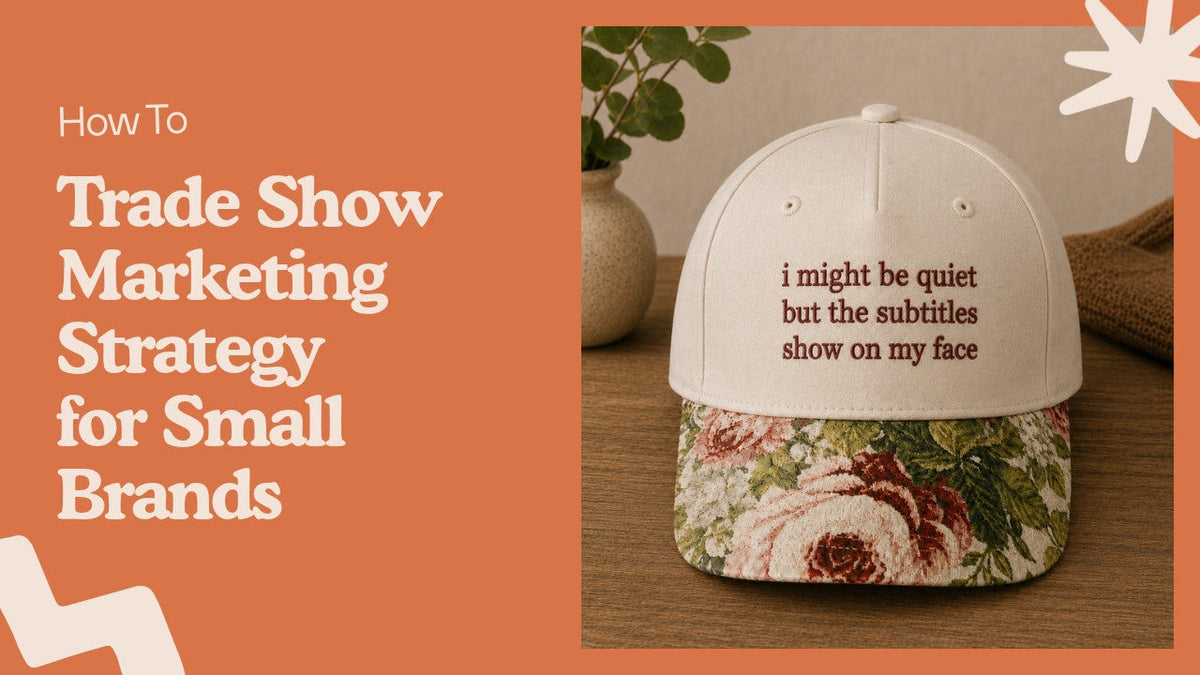
Got an introvert on your crew? Our "I might be quiet but the subtitles show on my face" floral hat is a fair warning to the rest of the booth. It is cotton twill with an adjustable strap for heads of about 21 to 24 inches.
What your booth team should wear
Matching clothes help a visitor see who works the booth and who is just browsing. This matters most when the booth is busy and people need to know whom to ask.
Three practical points for small teams:
- Exhibition halls swing between cold and stuffy. A heavyweight sweatshirt or a cap layers better than a stiff polo.
- Caps solve the sizing problem when you are ordering for people you don't know well. One size covers most heads.
- Choose a thread color with strong contrast to the fabric. Dark gray on black looks fine up close and disappears from six feet away.
We only do embroidery, not printing. Stitched designs sit inside the fabric and don't crack after repeated washes the way prints can. Our comparison of embroidery vs screen printing covers the trade-off.
Planning branded pieces? The guide on how to order custom embroidered merch walks through artwork and approvals.
Timing is the part people miss. Everything we make is stitched to order. Production plus shipping takes 3 to 7 business days, not counting weekends and US holidays. Order at least 10 days before you need the clothes.
Our sweatshirts run true to size with a relaxed cut, so only size up if someone is between sizes. For design ideas, browse these team shirt ideas or our embroidered hats and caps.
Giveaways that match the goal
Use this section once the goal is set, because the right giveaway depends on it. An awareness goal and a wholesale goal need very different things on the table.
If you want email signups, a low-cost item handed out for a signup works. For wholesale leads, hold back a better item or a real sample for people who finish a proper conversation. Place giveaways inside the booth, never on the front edge of the table. Otherwise people grab one and keep walking.
Count your giveaways at the end of each day. If two thirds are gone after day one of three, slow down and hand them out only after a real conversation. Running out on the last morning sends the wrong message to the buyers who come late.
We cover specific items elsewhere. Start with eco friendly promotional items for events and company swag ideas people actually use. There is also a longer list of trade show marketing tips for first-time booths.
Follow-up and measuring the results
This is the part of the plan that decides your return. Small brands have an advantage here. The person who met the lead can be the one who writes to them.
Sort leads on the show floor, not at home. A simple code works:
- A: ready to talk price or place an order. Call or email within 24 hours.
- B: interested but needs time, samples or approval. Email within 48 hours with the exact thing you promised.
- C: curious, no clear need. Add to your newsletter only if they agreed to it.
Mention something specific from the conversation in every first message. "You said the second shop opens in March" gets far more replies than "Great to meet you at the show."
Measure with numbers you can actually collect:
- Total cost divided by real conversations.
- Total cost divided by A and B leads.
- Orders and revenue from show leads at 30 days and again at 90 days.
- Return: revenue from show leads minus total cost, divided by total cost.
Wholesale buyers often take months to place a first order. A slow first month doesn't mean the show failed. Write down what worked while it is still fresh, and keep those notes for the next booking.
A one-page trade show plan you can copy
Use this as the sheet you print and tape inside a supply box. Fill it in during week 12 and update it the night before the show opens.
- Show name, dates, hall and booth number.
- The one goal, written as a number, plus the daily and hourly target.
- Total budget and the cost you can afford per conversation.
- Booth schedule: who opens, who explains, who records, and when each person takes a break.
- The opening question everyone will use, and the one sentence that explains what you sell.
- What each type of visitor takes home, and how many of each you packed.
- Lead codes A, B and C, and who follows up on each group.
- Dates to check results: 30 days and 90 days after the show.
If a line stays blank, that is the part of the plan still missing. Fix it before you load the car.
Selling to shoppers at a consumer show
Some events are open to the public, like craft fairs, home shows and holiday markets. The plan changes a little there. Sales at the booth matter more than leads, so bring enough stock and a card reader that works without Wi-Fi.
Price tags should be visible from the aisle. Shoppers rarely ask, and many walk on if they can't see a price. Keep a short email signup next to the register for people who want to buy later.
Mistakes that waste a trade show budget
These come up again and again with small exhibitors. Most of them cost more than the booth fee.
- Booking a show because a competitor is there, without checking who attends.
- Bringing every product. A crowded table makes it hard to see what you sell.
- Standing behind the table with arms crossed, or sitting down at the front.
- Collecting badges without notes, so nobody remembers who wanted what.
- Ordering signs and team clothing the week before, then paying rush fees or going without.
- Running out of samples on day one because nobody counted what each visitor took.
- Treating the show as finished on the last day instead of two days later.
Thanking the crew after the show
Three days on a hard floor is a lot to ask of friends, family or part-time help. A small thank-you gift that matches their sense of humor goes further than a gift card.

Think of the teammate who set up the booth, ran the card reader and fixed the banner in the same hour. The "You are not a jack of all trades" hat is a fitting joke for them. There is more in our work and coworker humor collection. Orders of three or more items ship free, which helps with a whole-crew order.
FAQ about trade show marketing strategy
What is a trade show marketing strategy?
It is a plan that links one event to one measurable goal. It also sets out the booth, staffing, giveaways and lead follow-up needed to hit that goal.
What is a good tradeshow strategy for a first-time exhibitor?
Pick one goal and turn it into a number of conversations per day. Keep the booth focused on a few products, and plan to contact every lead within 48 hours.
How far ahead should a small brand plan for a trade show?
Book the booth as early as the organizer allows, then start detailed planning about 12 weeks out. That leaves time for signs, samples and made-to-order team clothing without rush fees.
How much does a small trade show booth cost?
It depends on the show, so get real quotes for the booth, power, furniture, displays, giveaways, clothing and travel. Add about 10% as a buffer for things you missed.
What should booth staff wear at a trade show?
Matching tops or caps in a color that stands out from the booth backdrop, so visitors can tell staff from other attendees. Layers such as a sweatshirt help in halls that run cold.
How do you measure if a trade show was worth it?
Divide total cost by real conversations and by qualified leads, then track orders from those leads at 30 and 90 days. Compare that revenue with the total cost to get your return.
David Nguyen writes for the Me Do Embroidery team. We stitch every sweatshirt, hat and tote to order in the USA. Each new design is test-run on scrap fabric before it goes on a garment.