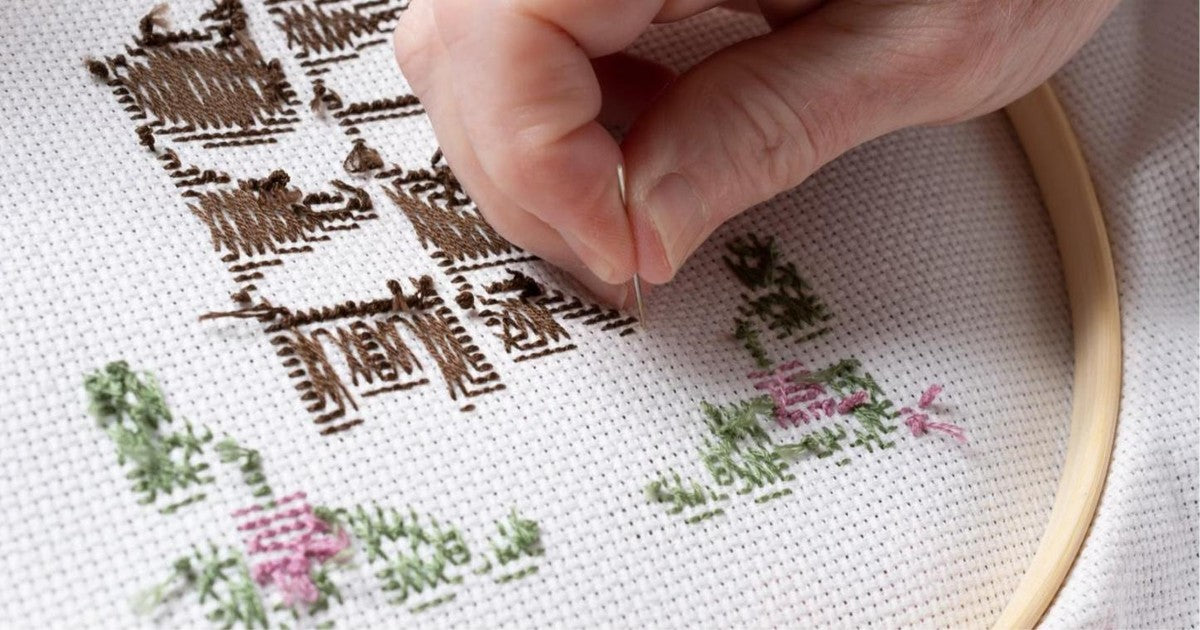
Quick answer: Blackwork embroidery is a counted-thread technique traditionally stitched in black silk thread on white or cream linen. It uses straight stitches, mainly double running stitch (Holbein stitch) and backstitch, to create repeating geometric fill patterns and outlines. Varying the density of the patterns creates light and shade, so blackwork can look almost like an ink drawing. It became popular in Tudor England in the 16th century.
Blackwork is graphic, modern-looking and surprisingly relaxing to stitch. Here's what it is, its history and how to start.
A Short History of Blackwork
Blackwork became fashionable in England during the reign of Henry VIII and is often linked with Catherine of Aragon, who is said to have brought Spanish-style blackwork to the English court. It decorated collars, cuffs and shirts and appears in many Tudor portraits, including works by Hans Holbein, which is why double running stitch is also called Holbein stitch.
What You Need
- Evenweave linen or Aida fabric (beginners can use 14- or 16-count Aida)
- Black thread: 1–2 strands of floss, perle cotton or silk
- A blunt tapestry needle
- A hoop and a charted pattern
Main Blackwork Stitches
- Double running (Holbein) stitch: a line of running stitches, then a return journey that fills the gaps. It looks the same on both sides.
- Backstitch: creates solid lines and outlines.
- Straight stitches: form the small units inside fill patterns.
How to Do Blackwork Embroidery
- Choose a chart with simple fill patterns.
- Find the center of your fabric and the chart.
- Stitch outlines first with backstitch, if the design includes them.
- Fill each area by repeating the charted pattern, counting fabric threads carefully.
- Use denser patterns for dark areas and open patterns for light areas.
- Weave thread ends under nearby stitches on the back.
Tips for Beautiful Blackwork
- Use fewer strands for delicate, airy patterns.
- Keep tension even so lines stay crisp.
- Try colored thread or metallic accents for a modern twist ("redwork" uses red thread).
- Plan the back if both sides will be visible; double running stitch keeps it reversible.
Frequently Asked Questions
Does blackwork have to be black?
No. Traditional blackwork is black, but any single dark color works, and modern pieces use many colors.
Is blackwork good for beginners?
Yes. It uses simple straight stitches; the main skill is careful counting.
Is blackwork the same as cross stitch?
No. Both are counted techniques on evenweave fabric, but blackwork uses line stitches, not crosses.
What fabric is best for blackwork?
Evenweave linen is traditional; Aida is easier for beginners.
Explore More Techniques
Learn about Hardanger embroidery and how to backstitch.
Love bold monochrome designs? Browse our embroidered T-shirts.