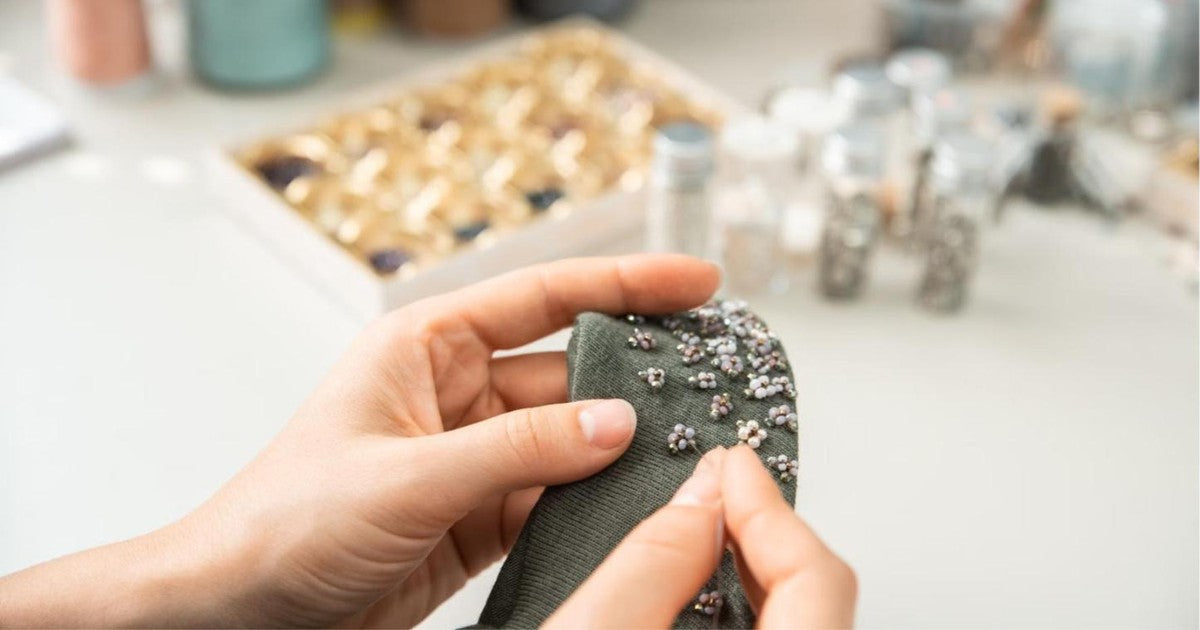
Quick answer: Tambour embroidery is a technique that uses a tiny hook, called a tambour hook, instead of a needle to make a continuous chain stitch on fabric stretched tight in a frame. The hook pushes through the fabric from the top, catches thread held underneath and pulls up a loop, creating fast, even chains. It's famous for attaching beads and sequins in haute couture, where it's often called Lunéville embroidery.
Tambour work is much faster than chain stitching with a needle and is a favorite of couture ateliers and bridal embroiderers. Here's what tambour embroidery is, where it comes from and how it works.
Where Tambour Embroidery Comes From
Tambour embroidery is believed to have origins in South and West Asia, including India and Persia, where hooked chain stitch work (such as aari work) has a long history. It spread to Europe in the 18th century. The name comes from the French word tambour, meaning drum, after the drum-like round frame used to hold the fabric. In the 19th century, embroiderers in Lunéville, France, began using the hook to apply beads and sequins, a style still used by luxury fashion houses.
Tools You Need
- A tambour hook and holder (needle sizes 70–120)
- A frame or hoop that holds fabric drum-tight
- Fine fabric like organza, tulle, silk or cotton
- Fine thread, such as cotton, silk or polyester
- Beads or sequins (for Lunéville work)
How Tambour Embroidery Works
- Stretch the fabric very tightly in a frame, design side up.
- Hold the thread underneath the fabric with one hand.
- With the hook's notch facing the stitching direction, push it through the fabric.
- Wrap the thread around the hook underneath, then turn the hook and pull up a loop.
- Move forward a short distance and repeat, pulling each new loop through the last one to form a chain.
- For beads, thread them onto the spool first and slide one up under each stitch (worked from the back of the fabric).
Tambour vs. Needle Chain Stitch
- Speed: tambour is much faster once learned.
- Look: both create a chain on the surface; tambour chains are very even.
- Beads: tambour attaches beads and sequins quickly in continuous lines.
- Learning curve: tambour takes practice to master the hook rotation.
Frequently Asked Questions
Is tambour embroidery hard to learn?
The motion feels awkward at first, but most people get comfortable after a few practice sessions.
What is Lunéville embroidery?
It's tambour embroidery used to apply beads and sequins, named after the French town where the technique developed.
Can you do tambour embroidery in a regular hoop?
Yes, for small projects, as long as the fabric is very taut. Larger work is easier on a slate or stand frame.
Is tambour the same as aari work?
They are closely related: both use a hook to make chain stitches. Aari is the South Asian tradition.
Explore More Techniques
Learn about other traditional styles like chikankari and 3D embroidery.
Prefer finished pieces? Shop our embroidered T-shirts.