
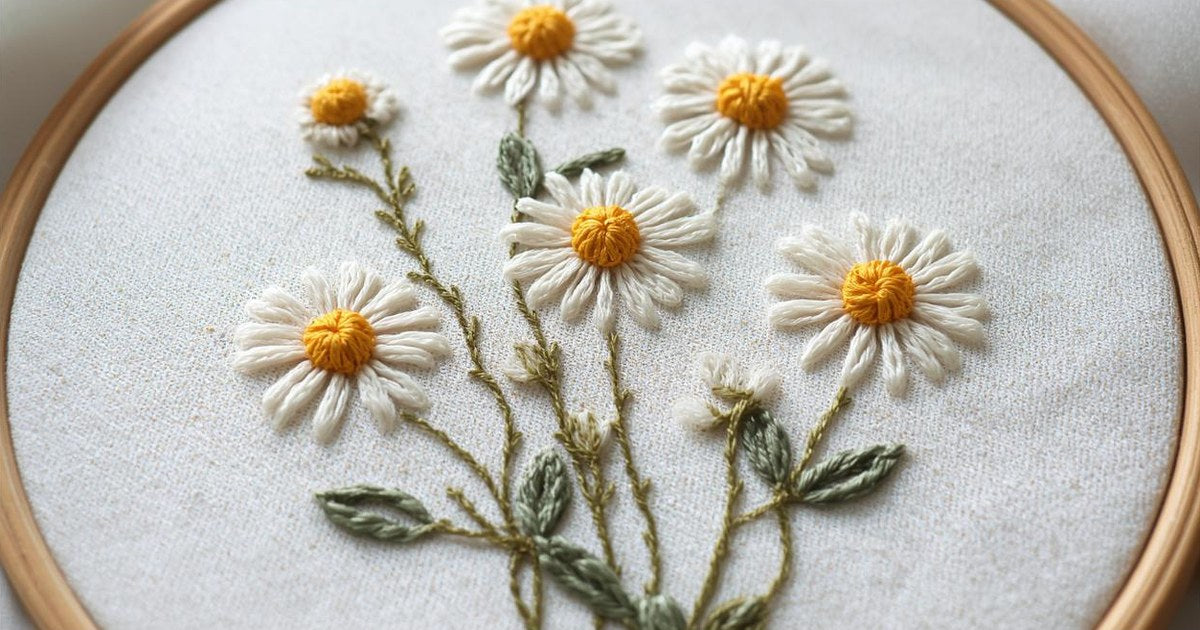
Quick answer: To make a French knot, bring the needle up through the fabric and hold the thread taut with your other hand. Wrap the thread around the needle 1–2 times. Keeping the thread snug, insert the needle back down very close to where it came up, but not in the same hole. Pull the needle slowly through the wraps to the back while still holding the thread taut, until a neat knot sits on the surface.
French knots add texture and dimension to embroidery. They're perfect for flower centers, eyes, dots and textured fills. They have a reputation for being tricky, but the secret is simple: keep tension on the thread the whole time. Here's how to make French knots step by step.
What Are French Knots Used For?
- Flower centers and tiny blossoms
- Eyes on animals and characters
- Dots, polka dots and dotted lines
- Textured fills such as sheep wool, trees or lamb fleece
- Decorative accents on clothing and gifts
What You Need
- Fabric in an embroidery hoop, hooped drum-tight
- Embroidery floss (2–6 strands depending on the knot size)
- An embroidery needle or milliner's needle. The straight shaft of a milliner's needle makes the wraps slide off easily.
How to Make a French Knot: Step by Step
- Bring the needle up from the back of the fabric where you want the knot.
- Hold the thread taut with your non-dominant hand, a few inches from the fabric.
- Wrap the thread around the needle once or twice, keeping the wraps close to the fabric.
- Insert the needle back into the fabric right next to where it came up, about 1 thread away. Don't go into the same hole, or the knot will pull through.
- Slide the wraps down the needle until they sit snug against the fabric.
- Pull through slowly. Keep holding the thread taut as you pull the needle to the back. Let go only at the very end.
- Secure it. Move to the next knot, or tie off on the back.
How Many Times Do You Wrap a French Knot?
Usually 1 or 2 wraps. For a bigger knot, add more strands of floss rather than more wraps. More than 2–3 wraps often makes a loose, floppy knot. If you want a long, coiled knot instead, try a bullion knot.
Why Do My French Knots Fail?
- The knot pulls through to the back: you went down in the same hole. Move over by one fabric thread.
- Loose, messy knots: the thread wasn't held taut while pulling through.
- Tangled loops: you pulled too fast. Pull slowly and steadily.
- Knots too small: use more strands of floss instead of extra wraps.
French Knot vs. Colonial Knot
A colonial knot is made with a figure-eight wrap instead of a spiral wrap. It sits a little taller and holds its shape well, which is why some stitchers find it easier. Both work well for flower centers and dots.
Frequently Asked Questions
Do you go back in the same hole for a French knot?
No. Go down right next to the original hole, about one fabric thread away, so the knot has something to sit on.
How do you make French knots bigger?
Use more strands of floss (4–6) or a thicker thread such as perle cotton, and keep to 1–2 wraps.
What needle is best for French knots?
A milliner's (straw) needle works best because its eye is the same width as the shaft. That lets the wraps slide off smoothly.
Can you do French knots without a hoop?
It's possible, but a hoop makes it much easier to keep the fabric and thread tension even.
Add Texture to Your Embroidery
With a little practice, French knots become quick and satisfying. Practice a row of 20 knots on scrap fabric, then use them to finish flower centers in your next project. For more stitch basics, see our guide on how to embroider.
Looking for embroidered gifts? Shop our personalized embroidered gifts and gifts for her.


