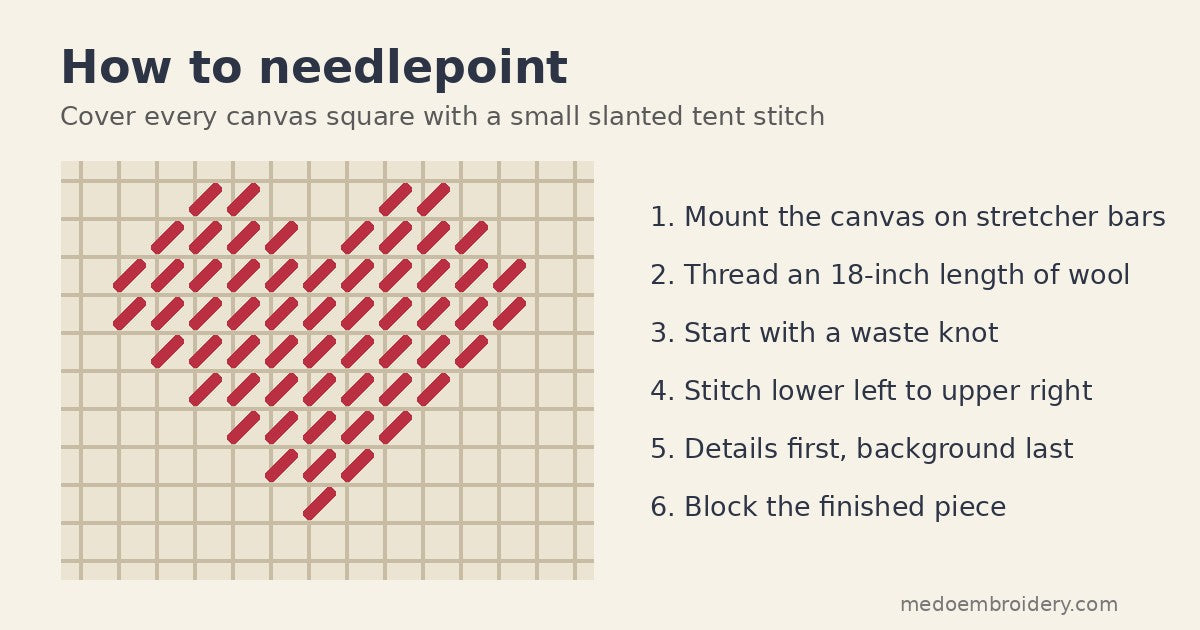
To needlepoint, stretch a painted canvas on stretcher bars and thread a blunt tapestry needle with wool or cotton. Then cover each square of the canvas with small slanted stitches called tent stitches. Start with a waste knot, work the details first, fill the background last, and finish by blocking the canvas flat.
This beginner guide covers supplies, the first stitches, and how to finish a piece.
Needlepoint vs embroidery vs cross stitch
Needlepoint is stitched on stiff open-weave canvas, and every hole is covered so no canvas shows. Embroidery is stitched on regular fabric, and the fabric shows between stitches. Cross stitch is counted on Aida or evenweave with X-shaped stitches. Read what is embroidery for more on the wider craft.
Needlepoint supplies
Canvas
- Mono canvas: single threads, the most common for painted canvases.
- Interlock canvas: threads locked at each crossing, so it frays less and suits half cross stitch.
- Penelope canvas: pairs of threads, so you can stitch fine detail and larger areas on the same piece.
Mesh size is the number of holes per inch. 13 mesh is a good first choice: big enough to see, small enough to show detail. 18 mesh is used for finer designs and ornaments.
Needles
Use a blunt tapestry needle: size 18 for 13 mesh and size 22 for 18 mesh.
Threads
Tapestry wool and Persian wool are traditional. Stranded cotton, perle cotton, silk and metallic threads add sheen and texture. The thread should cover the canvas without being so thick it is hard to pull through.
Frame
Stretcher bars or a scroll frame keep the canvas square and leave both hands free. A frame also reduces distortion.
How to needlepoint: step by step
- Tape the canvas edges with masking tape so they do not snag the thread.
- Mount the canvas on stretcher bars with tacks or staples, keeping it taut.
- Cut a length of thread about 18 inches long. Longer pieces fray as they pass through the canvas.
- Start with a waste knot. Tie a knot and go down from the front about an inch away, along the path you will stitch. Stitch toward it so the tail is covered, then snip the knot off.
- Bring the needle up in the lower left of the first square and down in the upper right. This makes one slanted stitch over one canvas intersection.
- Continue with tent stitch. Use continental stitch for lines and small details, and basket weave stitch for larger areas and backgrounds.
- Keep every stitch slanting the same way.
- End each thread by running it under 1 inch of stitches on the back, then trim.
- Stitch the design first and the background last.

Finishing your needlepoint
- Check the front for missed holes against a light.
- Block the piece: dampen it, pin it face down on a board in a square shape, and let it dry completely. This corrects any stretching.
- Turn it into a pillow, ornament, key fob, belt or framed piece. Many needlepoint shops offer professional finishing.
Beginner tips
- Choose a canvas with large color areas and a simple background.
- Let the needle hang every few stitches so the thread untwists.
- Do not carry thread across the back for more than a few holes. It shows through light areas.
- Work in good light. Missed holes are easier to see in daylight.
- Learn one decorative stitch at a time. Our list of needlepoint stitches has easy ones to try next.
Frequently asked questions
Is needlepoint hard to learn?
No. Tent stitch is one diagonal stitch repeated, and most beginners pick it up in a single sitting.
How long does a needlepoint project take?
A 4-inch ornament on 18 mesh may take a few evenings. A 14-inch pillow on 13 mesh can take several weeks of regular stitching.
Can I needlepoint without a frame?
Yes, especially on small pieces, but the canvas will distort more and need firmer blocking.
What thread is best for beginners?
Tapestry wool on 13 mesh. It covers well, is easy to handle, and hides small tension differences.
Explore more stitching
Like counted work? Compare with how to cross stitch. Want to add texture to embroidery? Try the embroidery knot stitches guide.
Prefer to wear stitched designs? Shop our embroidered hoodies and sweatshirts.