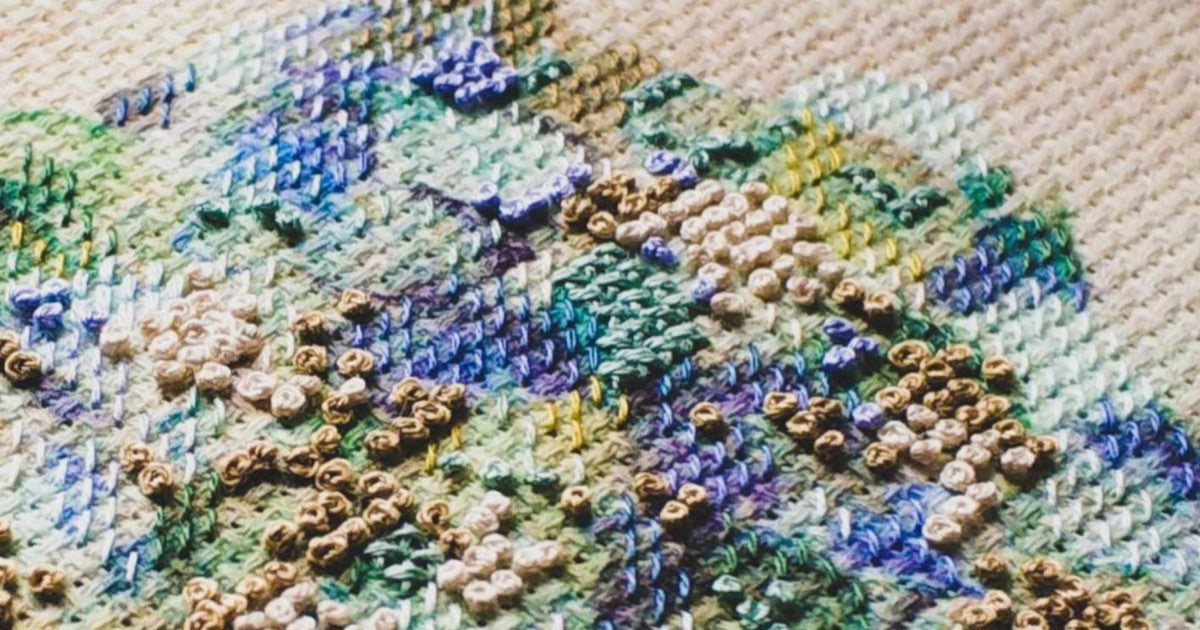
An embroidery knot stitch is any stitch that forms a raised knot on the surface of the fabric. The most common are the French knot, colonial knot, bullion knot, four-legged knot and Chinese knot. They are used for flower centers, eyes, berries, dots, seeds and textured fills.
Each knot below includes what it looks like, when to use it, and how to stitch it.
Quick comparison
| Knot | Shape | Best for | Difficulty |
|---|---|---|---|
| French knot | Small round dot | Flower centers, eyes, dots | Easy |
| Colonial knot | Round dot, slightly taller | Candlewicking, dense fills | Easy |
| Bullion knot | Long coiled bar | Roses, petals, caterpillars | Medium |
| Four-legged knot | Cross with a knot in the middle | Borders, geometric fills | Easy |
| Chinese knot | Flat, firm dot | Seeds, textured areas | Medium |
| Coral stitch | Line of evenly spaced knots | Stems, textured outlines | Easy |
| Pistil stitch | Knot on the end of a straight stitch | Flower stamens | Easy |
French knot
Bring the needle up and wrap the thread around it 1 to 3 times. Push the needle back down just next to where it came up. Hold the working thread taut while you pull through. More wraps or more strands make a bigger knot. Our full tutorial on how to make French knots covers common problems.
Colonial knot
The colonial knot wraps the thread in a figure eight around the needle instead of in a coil. It holds its shape better than a French knot and does not pull through as easily. It is the traditional knot in candlewick embroidery.
- Bring the needle up.
- Pass the needle under the thread from right to left.
- Wrap the thread over the needle tip, then under it, forming a figure eight.
- Insert the needle close to the starting point, tighten the thread and pull through.
Bullion knot
A bullion knot is a coil of thread laid flat on the fabric, like a small caterpillar. Groups of curved bullions form roses.
- Bring the needle up at point A.
- Go down at point B, the length you want the knot to be. Come back up at A without pulling the needle all the way through.
- Wrap the thread around the needle tip until the wraps cover the distance from A to B.
- Hold the wraps with your thumb and pull the needle through.
- Lay the coil down toward B and insert the needle at B.
A milliner's needle helps, because its eye is the same width as the shaft and slides through the wraps.
Four-legged knot
Make a vertical straight stitch. Bring the needle up at the left side of the center. Slide it under the crossing point without entering the fabric, loop the thread under the tip, and pull to form a knot. Finish with a stitch down on the right side. The result is a small cross with a knot in the middle.
Chinese knot (Peking knot)
This is a flat knot. You form a loop on the fabric surface, insert the needle inside the loop, and tighten it close to the fabric. Traditional Chinese embroidery uses rows of these knots to fill whole shapes.
Coral stitch
Coral stitch makes a line with small knots at intervals. Lay the thread along the line, take a tiny stitch under the fabric, loop the thread under the needle tip, and pull through. Repeat along the line.
Pistil stitch
A pistil stitch is a French knot with a tail. Wrap the thread as for a French knot, but insert the needle a short distance from where it came up. It is the usual stitch for stamens.
Tips for neat knots
- Use a hoop. Tight fabric stops knots from sinking.
- Do not insert the needle in the exact same hole you came up from, or the knot will pull through.
- Change the number of strands, not just the number of wraps, to change the knot size.
- Stitch knots last, after flat stitches, so they do not get flattened.
Frequently asked questions
Which embroidery knot is easiest for beginners?
The French knot. It needs one motion and works with any thread.
Why do my knots disappear to the back?
The needle went back into the same hole, or the thread was not held taut while pulling through.
Can I use knot stitches in cross stitch?
Yes. Charts often add French knots for eyes and small dots. Use 1 or 2 strands on 14-count fabric.
More stitch guides
Pair knots with outlines from stem stitch and chain stitch, or fill petals with satin stitch. New to hand embroidery? Start with how to embroider.
See knot stitches on finished pieces in our embroidered hoodies and sweatshirts.