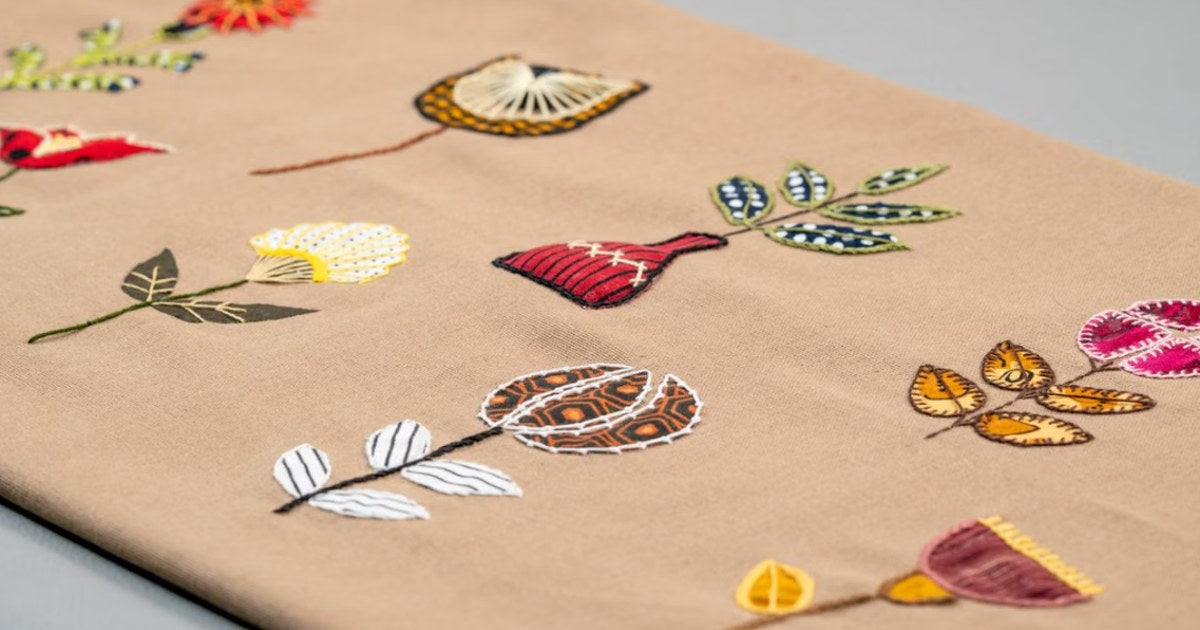
The applications of embroidery reach into daily life more than most people notice. Stitched designs appear on caps, school uniforms, bath towels, church vestments and museum walls. This guide sorts embroidery by what it is used for. Where a fact comes from a museum or reference source, the source is linked.
Embroidery applications at a glance
| Application | Common items | Usual method |
|---|---|---|
| Clothing decoration | Sweatshirts, hoodies, jackets, collars | Machine or hand |
| Logos and identity | Caps, uniforms, team jackets, patches | Machine |
| Personalized gifts | Names, initials, dates, pet outlines | Machine |
| Home decor | Towels, pillows, curtains, bed linens | Machine or hand |
| Repair and strengthening | Workwear, worn knees, holes | Hand |
| Religious and ceremonial | Vestments, regalia, uniforms | Hand, often goldwork |
| Art and storytelling | Wall hangings, samplers, framed hoops | Hand |
Embroidery on clothing
Embroidery life starts with clothing for most people. A small chest logo, a name on a sleeve or a phrase across a sweatshirt are all embellishment applications of the same idea.
The V&A shows this is not new. Blackwork decorated caps, collars, cuffs and sleeves across 16th- and 17th-century Europe (V&A, Embroidery styles). Whitework such as Ayrshire work trimmed collars, cuffs, bonnets and robes in early 19th-century Scotland.
For style ideas, read our guide on how to style a sweatshirt.
Logos, uniforms and identity
Businesses, schools and teams put stitched logos on caps, polos and jackets. Machine embroidery repeats the same design on every piece once it is digitized. Our guide on embroidery digitizing explains that step.
Caps often use raised 3D puff stitching for bold logos. See what is 3D embroidery and our best hats for embroidery.
The V&A notes that goldwork still appears on military and ceremonial regalia.
Personalized gifts
A name, initials or a wedding date turns a plain item into a gift. Common examples include baby blankets, monogrammed robes, couple sweatshirts and "Est." hoodies for new parents. Browse our personalized embroidered gifts for examples.
Home decor
Embroidery has dressed beds and windows for centuries. The V&A records crewelwork bed hangings and curtains in late 17th-century England. Canvas work covered cushions and upholstery from the 16th century, and Berlin woolwork decorated Victorian furniture.
Today, the most common home items are monogrammed towels, pillow covers and table linens. Our guide on how to embroider a towel covers a home project.
Repair and strengthening
Embroidery can make fabric stronger. The V&A explains that Japanese kogin, from Aomori Prefecture, began as darning stitches that strengthened farmers' winter workwear. Stitching over a worn area or a small hole works the same way on jeans and jackets today.
Religious and ceremonial embroidery
Britannica notes that embroidery in northern Europe was mostly religious until the Renaissance (Britannica). English goldwork known as "opus anglicanum" peaked between 1250 and 1350, according to the V&A. The V&A says goldwork is still used in religious regalia.
Art and storytelling
Embroidery can tell a story across many meters of cloth. The Bayeux Tapestry is wool embroidery on linen, nearly 70 meters long. It shows William, Duke of Normandy, conquering England in 1066 (Bayeux Museum). Samplers, framed hoops and textile art carry that tradition into homes and galleries. Read more in our history of embroidery.
Hand vs machine applications
| Use | Hand embroidery | Machine embroidery |
|---|---|---|
| One-of-a-kind art | Common | Rare |
| Team or business orders | Rare | Common |
| Repair and mending | Common | Rare |
| Names and monograms | Possible | Common |
Machine embroidery has a long history too. Isaak Gröbli developed the Schiffli embroidery machine in St. Gallen in 1863 (TRC Leiden). For the names of each hand and machine style, see our guide to types of embroidery.
Frequently asked questions
What are the main applications of embroidery?
Clothing decoration, logos and uniforms, personalized gifts, home decor, repair, religious items and textile art.
How is embroidery used in everyday life?
On cap logos, school and work uniforms, monogrammed towels, pillow covers and personalized sweatshirts.
What are embellishment applications in embroidery?
Adding stitched decoration to a finished item, such as a logo on a cap, a name on a sleeve or a monogram on a towel.
Can embroidery repair clothes?
Yes. Stitching over a worn spot strengthens it. Japanese kogin began as stitching that reinforced farmers' workwear, according to the V&A.
Is embroidery used in religious clothing?
Yes. The V&A lists religious regalia among the uses of goldwork. Britannica notes northern European embroidery was mostly religious until the Renaissance.
When is machine embroidery better than hand embroidery?
For many identical pieces, like team caps or business uniforms, because the machine repeats one digitized design.